

When an unattended death occurs in a Colorado home, apartment, or rental property, the first practical question after authorities release the scene is often a painful one: Who is responsible for paying for the cleanup?
The short answer is that there is no single Colorado rule making “the family” automatically responsible for every unattended-death cleanup bill. The person who authorizes the work, the person legally responsible for the property, and the party that ultimately reimburses the cost may be three different people or organizations.
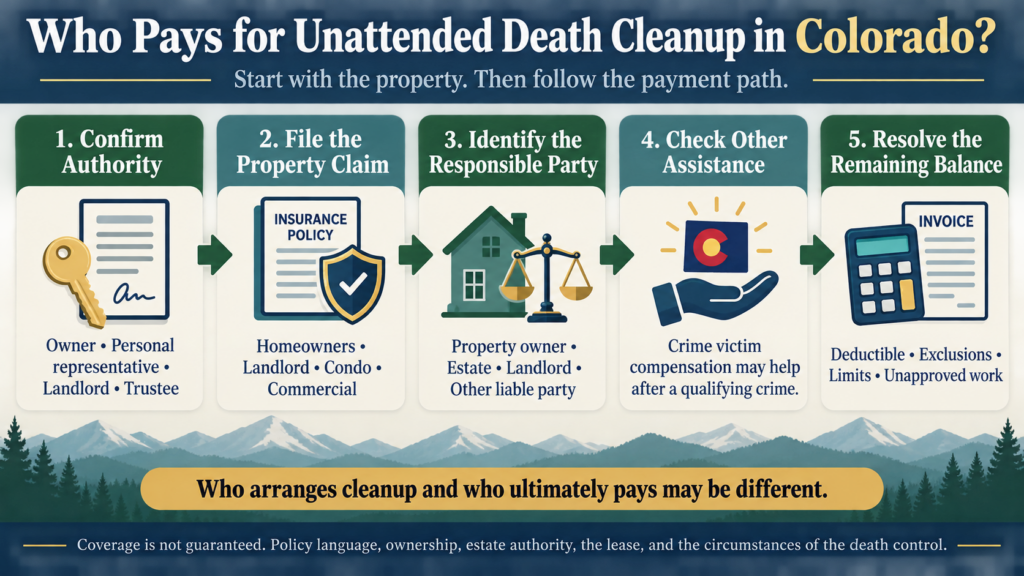
In many cases, a homeowners, landlord, or commercial property insurance policy pays some or most of the covered remediation cost after the deductible. When insurance does not apply, the cost may be paid by the property owner, the decedent’s estate, a landlord, or—when a qualifying crime caused residential property damage—potentially Colorado’s crime victim compensation system. The result depends on the property, the policy, the circumstances of the death, and the authority of the person hiring the cleanup company.
This guide explains the most common Colorado payment paths. It is general educational information, not legal or insurance advice. Families, personal representatives, landlords, and property managers should obtain advice about their specific policy, lease, estate, or claim when responsibility is disputed.
Also Read 👉🏻What Are the Health Risks of Living in a Meth-Contaminated Home?
The Most Important Distinction: Who Arranges Cleanup Is Not Always Who Ultimately Pays
An unattended death can leave blood, bodily fluids, decomposition residue, odors, insects, and contamination inside porous building materials. The coroner, law enforcement agency, funeral home, or body-transport service does not normally restore the property after the body has been removed.
Someone with legal authority over the premises must therefore arrange remediation. That may be:
- The homeowner
- A surviving co-owner
- The personal representative of the estate
- A trustee
- A landlord or property-management company
- A bank, receiver, or other party controlling the property
- An authorized family member acting for one of those parties
That person may sign the work authorization, while an insurer later pays the covered portion directly to the contractor or reimburses the insured. If a claim is denied, the person or entity responsible for the property may have to pay first and later seek reimbursement from an estate, tenant, liable person, or other source.
Practical rule: Do not assume that signing a cleanup authorization guarantees insurance coverage, and do not assume that being a relative automatically gives someone authority to enter the property, discard belongings, or bind an estate to a contract.

Does Homeowners Insurance Pay for Unattended Death Cleanup?
Often, but not automatically.
Many homeowners policies insure the dwelling against direct physical loss unless the loss is excluded. Depending on the policy language and facts, covered work may include removal of contaminated flooring, subfloor, drywall, baseboards, or other building materials; cleaning and decontamination; odor treatment; and restoration of damaged portions of the structure.
Coverage is decided under the actual policy—not by a universal rule that all biohazard cleanup is covered. The adjuster may examine:
- The cause and date of loss
- Whether the loss was sudden, accidental, or excluded
- Whether contamination affected the insured structure, personal property, or both
- Whether the policy contains biological-material, pollution, vacancy, neglect, intentional-act, or other exclusions
- Whether mitigation was reasonable and necessary
- Whether the home was occupied, vacant, or unoccupied under the policy definitions
- Applicable deductibles and coverage limits
- Whether repair or reconstruction is included after contaminated materials are removed
The National Association of Insurance Commissioners cautions that environmental or contamination-related losses may be restricted or excluded under standard property policies unless the policy provides applicable coverage. That is why no reputable remediation company should promise that an insurance carrier will pay before the carrier reviews the claim and policy.
Also Read 👉🏻How Do Buyers Discover Meth Contamination During Home Inspections?
What Should Be Done Before Cleanup Begins?
Once law enforcement or the coroner has released the scene:
- Prevent unnecessary entry and avoid disturbing the affected area.
- Locate the declarations page and full insurance policy if possible.
- Report the loss promptly to the property insurer.
- Ask whether the carrier wants photographs, an adjuster inspection, an estimate, or specific documentation before removal begins.
- Obtain a written scope of work from a qualified biohazard remediation company.
- Preserve invoices, photographs, disposal documentation, authorization records, and communications with the insurer.
- Ask the insurer in writing what it has approved, what remains under review, and which deductible applies.
Urgent mitigation should not be delayed when delay would allow contamination, insects, or odors to spread. However, the work should be documented before and during remediation whenever lawful and appropriate.
Also Read 👉🏻How Do You Know If a Cleanup Company Is Actually Qualified?
Will Insurance Pay the Entire Bill?
Not necessarily. Even an accepted claim can leave the insured responsible for:
- The deductible
- Work outside the approved scope
- Non-covered personal property
- Upgrades or remodeling beyond like-kind repairs
- Costs above a limit or sublimit
- Work the carrier considers unrelated to the covered loss
- Charges excluded by the policy
Insurance may also separate remediation from reconstruction. Removing contaminated carpet, drywall, or subfloor does not necessarily mean the same company or payment will cover replacement flooring, painting, cabinetry, or other finish work.
Colorado consumers who cannot resolve a claim concern with their carrier can find insurance assistance through the Colorado Division of Insurance.
Can the Decedent’s Estate Pay for the Cleanup?
Potentially, yes—but the estate is not automatically the payer in every situation.
An estate is the legal pool of the decedent’s assets and obligations. A properly appointed personal representative has duties and powers relating to estate property. If the deceased person owned the affected home, a necessary cleanup may be treated as a cost of protecting, preserving, administering, or preparing estate property for transfer or sale. Whether a particular invoice qualifies, and how it should be classified, can depend on the facts and probate advice.
Colorado’s probate law gives priority to “other costs and expenses of administration” ahead of many other claims against an estate. The statutory order appears in C.R.S. § 15-12-805. That statute does not specifically say that every unattended-death cleanup invoice is an administration expense. It does, however, provide the framework a personal representative and probate attorney may use when evaluating necessary costs and competing claims.
Also Read 👉🏻What Role Do Air Scrubbing, VOC Control, and CLO₂ Play in Meth Remediation?
What If Probate Has Not Been Opened Yet?
This is where families can unintentionally create problems. A relative may have the keys and be trying to help, but possession of the keys does not necessarily create legal authority to spend estate money, enter into a contract for the estate, or dispose of property.
Before authorizing major removal or signing in the estate’s name, confirm who has authority. Depending on the situation, that could be:
- A court-appointed personal representative
- A special administrator
- A surviving joint owner
- A trustee when the property is held in trust
- An agent whose authority remains legally effective for the act in question
- Another person authorized by the owner or a court
A power of attorney generally ends at the principal’s death. Someone who acted as agent during the decedent’s life should not assume the same document authorizes post-death decisions.
If immediate action is necessary to stop additional property damage, document why the work could not reasonably wait and obtain probate counsel as quickly as possible.
What If the Estate Has Little or No Money?
An insolvent or asset-poor estate may be unable to reimburse cleanup costs. Heirs do not ordinarily become personally liable for all estate expenses merely because they are related to the deceased. Personal liability can arise from a person’s own contract, ownership duties, improper distributions, misconduct, lease obligations, or other independent legal grounds, but family relationship alone is not the same thing as agreeing to pay.
Before signing, ask the cleanup company to identify:
- The customer named in the agreement
- Who is personally responsible if insurance denies the claim
- Whether the contractor accepts assignment or direct payment from insurers
- Whether a deposit is required
- How change orders are approved
- What happens if the estate lacks funds
Who Pays When the Death Occurs in a Rental Property?
Rental situations require separate analysis because property ownership, possession, insurance, and lease obligations are divided among different parties.
The Landlord or Property Owner
The owner commonly must arrange restoration of the building and make decisions about contaminated structural materials. Colorado’s warranty of habitability law says every residential landlord warrants that the premises are fit for human habitation. Under C.R.S. § 38-12-503, a landlord who receives the required notice can have duties to respond and remediate conditions that materially interfere with life, health, or safety. The statute also states that a landlord receiving notice of a habitability issue is responsible for remediation to a habitable standard at the landlord’s expense, subject to the law’s terms, exceptions, defenses, and procedures.
That does not mean the landlord must absorb the final cost in every unattended-death case. The owner may:
- Submit a claim under a landlord or commercial property policy
- Seek payment under an applicable lease provision
- Make a claim against the tenant’s estate
- Pursue a legally responsible third party
- Use a security deposit only as Colorado law and the lease permit
The immediate habitability duty and the ultimate allocation of financial responsibility are separate questions.
The Tenant’s Estate or Family
The tenant’s estate may be responsible for obligations arising under the lease or for damage legally attributable to the tenant. Whether cleanup is chargeable to the estate depends on the lease, the facts, insurance, Colorado probate rules, and other applicable law.
Family members should not assume they must personally pay a landlord simply because the deceased was their relative. Likewise, landlords should not assume that every cleanup charge can automatically be deducted from a security deposit or billed to relatives without following Colorado law.
Renters Insurance
Renters insurance may cover some affected personal property and may include liability or additional-living-expense provisions relevant to surviving occupants. It usually does not insure the landlord’s building itself. The tenant’s carrier and the landlord’s carrier may therefore address different parts of the same loss.
Also Read 👉🏻How Can Hidden Odors Destroy Property Value and Tenant Retention?
What If the Property Is a Condominium, Townhome, or HOA Community?
Responsibility may be divided among:
- The unit owner’s policy
- The condominium association’s master policy
- The association’s governing documents
- The owner’s estate
- A neighboring unit owner’s policy if contamination spread
The location of the damage matters. A unit policy may address interior finishes or contents, while a master policy may address common elements or portions of the structure. The declaration, bylaws, maintenance responsibilities, and insurance provisions should be reviewed before assuming that either the estate or HOA owes the entire amount.
Can Crime Victim Compensation Help Pay?
Possibly, when the death or property damage resulted from a qualifying crime. It is not a general fund for natural deaths, suicides, or every unattended-death scene.
Colorado’s Crime Victim Compensation Act allows compensation for certain losses arising from compensable crimes. Following statutory changes, covered property losses may include repair or replacement of residential property damaged because of a compensable crime and, in some situations, payment of a residential insurance deductible. Eligibility, documentation, deadlines, collateral-source rules, and award limits apply. The local judicial-district board evaluates the claim.
The current statutory categories are found in C.R.S. § 24-4.1-109. Applicants can also start with the Colorado judicial-district victim compensation information and then contact the program for the district where the crime occurred.
Because the fund is generally a payer of last resort, applicants should expect questions about insurance and other available payments. Do not wait for an insurance dispute to end before asking the appropriate board about its filing requirements and deadlines.
Also Read 👉🏻What Goes Into a Biohazard Cleanup? Colorado Safety Protocols & Certification Requirements
Is the County, Coroner, Police Department, or State Responsible for the Cleanup Bill?
Usually not.
Public officials investigate the death, secure the scene when necessary, collect evidence, determine cause and manner of death, and authorize removal of the body. Those public functions are different from restoring a private residence.
Law enforcement may keep a scene restricted while an investigation is active. Cleanup should begin only after the appropriate authority has released the scene. Once released, the owner or another legally authorized party generally coordinates private-property remediation and pursues the available payment source.
An exception may exist where a statute, court order, government program, restitution order, responsible third party, or unusual factual circumstance shifts part of the cost. Those cases require individualized review.
Colorado Rules Affect How Contaminated Waste Must Be Managed
Payment responsibility is only one part of the problem. Cleanup must also be performed and documented in a way that protects occupants, workers, transporters, and disposal facilities.
Colorado’s solid-waste system is administered by the Colorado Department of Public Health and Environment and local authorities. The official Colorado solid-waste regulations link to 6 CCR 1007-2, while the Secretary of State maintains the official current version of 6 CCR 1007-2 Part 1. Section 13 addresses infectious waste, including requirements relevant to containment, storage, treatment, transportation, and disposal.
Not everything removed from an unattended-death scene is automatically infectious waste, and not all contaminated materials are handled identically. Classification depends on the material and contamination. A qualified remediation provider should separate ordinary solid waste from regulated material, use suitable containers and labels, control sharps hazards, maintain any required records, and use an appropriate waste transporter and receiving facility.
This is one reason ordinary housekeeping or a do-it-yourself approach can create both health and disposal problems. Visible staining is not the boundary of contamination, and strong odor alone does not show whether a material has been adequately cleaned.
Who Pays in the Most Common Colorado Scenarios?
Owner-Occupied Home With Active Homeowners Insurance
The homeowner or authorized estate representative usually arranges cleanup. A homeowners claim may pay covered costs after the deductible. The owner or estate pays excluded items, the deductible, and any amount above limits.
Owner-Occupied Home With No Insurance
The owner pays. If the owner died, an authorized personal representative may use estate funds when legally appropriate. If the estate lacks money, the family should not assume personal liability without reviewing ownership and any contract they are asked to sign.
Rental Apartment
The landlord commonly arranges remediation of the building to restore habitability and may submit a property claim. The tenant’s estate or renters insurer may address contents, lease obligations, or liability. Final responsibility depends on the lease, cause, policies, and law.
Condominium
The unit owner or estate, unit insurer, and association may each have a role. The affected component and governing documents determine which policy responds.
Death Caused by a Crime
Property insurance remains an important first step. The victim’s family or affected homeowner may also ask the appropriate Colorado Crime Victim Compensation Board whether residential cleanup damage or the deductible qualifies.
Property Managed for an Absentee Owner
The property manager should follow the management agreement and obtain the owner’s authorization unless emergency powers apply. The owner’s or commercial policy may respond. A manager should avoid signing personally when acting solely as the disclosed agent for the owner.
A Step-by-Step Payment Checklist
1. Confirm the Scene Has Been Released
Do not enter, move items, or begin remediation until the investigating authority permits it.
2. Identify the Legal Decision-Maker
Confirm ownership and the authority of the personal representative, trustee, landlord, manager, or co-owner. Do not rely only on family status.
3. Locate Every Potential Policy
Look for homeowners, landlord, renters, condominium, commercial property, and umbrella policies. If the deceased owned the property, the personal representative may need to contact the agent or carrier.
4. Open the Claim Promptly
Ask for the claim number, adjuster’s contact information, documentation requirements, emergency-mitigation instructions, deductible, and any known coverage concerns.
5. Obtain a Written Remediation Scope
The scope should distinguish cleaning, demolition, contents handling, disposal, odor treatment, testing when appropriate, and reconstruction.
6. Clarify Financial Responsibility Before Signing
Read the payment clause carefully. Ask what happens if the carrier pays less than the invoice or denies the claim.
7. Preserve Evidence and Records
Keep photographs, estimates, invoices, waste records, estate documents, leases, policies, adjuster communications, and proof of payment.
8. Escalate Disputes Early
Coverage disputes may require the carrier’s internal review, help from the Colorado Division of Insurance, a public adjuster where appropriate, probate counsel, insurance counsel, or another qualified professional.
Also Read 👉🏻Indoor Airborne Contaminants: Hidden Risks in Your Home & How to Eliminate Them
Common Myths About Unattended Death Cleanup Payment
“The Police Pay Because It Was Their Scene”
Investigation does not ordinarily make law enforcement responsible for private-property restoration.
“The Next of Kin Always Has to Pay”
Kinship alone does not automatically transfer every cleanup debt to a relative. Ownership, estate authority, contractual promises, lease duties, and other legal grounds matter.
“If Insurance Opens a Claim, the Work Is Covered”
A claim number confirms that a claim exists, not that every charge has been approved. Coverage and scope still require evaluation.
“The Estate and the Family Are the Same Thing”
They are not. The estate is a legal entity administered under probate law. A family member can create personal exposure by signing an agreement individually rather than in a properly authorized representative capacity.
“Odor Removal Alone Means the Property Is Safe”
Odor treatment is not a substitute for locating, removing, or decontaminating affected material. Successful remediation addresses the source before cosmetic restoration.
Also Read 👉🏻How Is Meth Remediation Actually Performed in a Colorado Home?
Questions to Ask a Colorado Unattended-Death Cleanup Company
- Who must sign the authorization, and how do you verify authority?
- Will you provide a line-item written scope and estimate?
- How do you document the loss for an insurance adjuster?
- Which services are remediation, and which are reconstruction?
- How are contaminated porous materials identified and removed?
- How is regulated waste packaged, transported, and disposed of?
- What training and worker-protection procedures does your team use?
- Will you communicate directly with the adjuster while keeping the customer informed?
- What costs remain the customer’s responsibility if coverage is limited or denied?
- What clearance or completion documentation will be provided?
The Bottom Line: Start With Authority, Insurance, and Documentation
Families facing an unattended death are often asked to make unfamiliar decisions while grieving. The financial uncertainty can make an already overwhelming situation feel impossible. In Colorado, the best starting point is not to assume that the closest relative must pay. First determine who legally controls the property, identify every potentially applicable policy, notify the carrier, and document the scene and proposed work before material is removed whenever circumstances allow.
The bill may ultimately be divided among insurance, the property owner, the decedent’s estate, a landlord, or another legally responsible source. When a qualifying crime caused residential property damage, crime victim compensation may provide another path. Colorado probate, habitability, victim-compensation, and waste rules each address a different part of the problem; none should be treated as a blanket promise of payment.
Denver Decon helps property owners, families, landlords, and property managers identify the affected area, develop a clear remediation scope, document necessary work, and restore the property with dignity and discretion. The goal is not to sell unnecessary services. It is to remove the health risk, explain what the property actually needs, and give the responsible decision-maker usable documentation for the insurer, estate, or property file.
For confidential help in Metro Denver and communities north of Denver, contact Denver Decon or call 720-825-2130. A careful professional assessment can replace guesswork with a defensible plan and help move the property toward safe use again.

Colorado Legal and Regulatory References
- C.R.S. § 15-12-805 — Classification and priority of estate claims
- C.R.S. § 38-12-503 — Colorado warranty of habitability and landlord obligations
- C.R.S. § 24-4.1-109 — Losses compensable under the Crime Victim Compensation Act
- Colorado Secretary of State — Official 6 CCR 1007-2 Part 1 rule page
- Colorado Department of Public Health and Environment — Solid-waste regulations and statutes
- Colorado Division of Insurance — Consumer insurance resources
Legal-review note for publication: Colorado laws and regulations can change. Confirm the current text and consider attorney review before presenting this article as guidance for a specific claim, probate matter, or landlord-tenant dispute
Frequently Asked Questions
Should I Turn Off My AC if It Is Frozen?
Yes. Turn cooling off and allow the system to thaw completely. If the blower operates normally, setting the fan to On may help move warm air across the coil.
Can a Dirty Air Filter Make an AC Freeze?
Yes. A clogged or overly restrictive filter can reduce airflow across the evaporator until the coil becomes cold enough to freeze accumulated condensation.
Will a Frozen AC Fix Itself?
The ice may melt after the system is turned off, but the underlying cause will remain unless it was a temporary and fully corrected airflow restriction. An air conditioner that freezes again needs professional diagnosis.
How Long Should I Leave My AC Off When It Is Frozen?
Leave cooling off until the evaporator coil has thawed completely. Depending on the amount and location of the ice, this can take several hours or longer.
Can I Pour Hot Water on a Frozen Evaporator Coil?
No. Rapid temperature changes, water near electrical components, and improper handling can damage the equipment or create a safety hazard. Do not chip, scrape, or forcibly heat the ice.
Does a Frozen AC Always Need Refrigerant?
No. Icing can result from low airflow, dirty components, blower failure, duct restrictions, control problems, low refrigerant, or a refrigerant-metering defect. Ice alone does not prove that refrigerant must be added.
Why Does My AC Freeze Only at Night?
Cooler outdoor conditions, reduced indoor heat load, a very low thermostat setting, or a marginal airflow or refrigerant problem may cause icing to appear during nighttime operation.
Can Closing Vents Cause the AC to Freeze?
Closing a small number of vents may not cause an immediate problem, but closing too many can raise duct pressure and reduce total system airflow enough to contribute to evaporator-coil icing.
Why Is Water Leaking After My AC Thaws?
Melting ice may release more water than the condensate system can handle, or it may melt outside the normal drainage path. A blocked drain, damaged pan, or improperly installed coil can make the leakage worse.
How Much Does It Cost to Repair a Frozen Air Conditioner?
The cost depends on the confirmed cause. A filter correction may be minor, while blower replacement, coil cleaning, duct repair, refrigerant-leak repair, or component replacement requires more extensive work. The presence of ice alone cannot determine the repair price.