
Quick answer: Hoarding conditions become a biohazard concern when accumulated belongings conceal or spread potentially harmful biological material, such as human or animal waste, sewage, rodent droppings, decaying food, or blood. A home may also be unsafe without a biological contaminant if exits, cooking areas, utilities, or access for emergency responders are blocked. The right response depends on the actual hazards, not how much stuff is visible.
A family member opens the door and sees only a narrow path through a room. A property manager receives a complaint about an odor coming from one apartment. A social worker notices that the bathroom can no longer be used. In each case, the immediate question is less about whether the home looks tidy and more about whether someone can live, work, or enter there safely.
The term hoarding disorder describes a mental health condition involving persistent difficulty discarding possessions and impaired use of living spaces. A cleanup contractor cannot diagnose it from a photograph. Likewise, clutter alone is not proof of a biohazard. The International OCD Foundation and the American Psychiatric Association emphasize functional impairment and the person's experience, while the U.S. Fire Administration separately warns about fire and escape risks from accumulated materials.
This guide explains the warning signs, how to decide which professionals to call, and what a respectful cleanup plan looks like for families, landlords, property managers, social workers, and facility managers in the Denver area.
Also Read 👉🏻How Do Buyers Discover Meth Contamination During Home Inspections?
What does “biohazard” mean in a hoarded home?
A biohazard is a biological source that may expose people to illness or injury. In a hoarded property, the concern may be obvious, such as a sewage overflow, or hidden below possessions, such as rodent nests, feces, blood-contaminated materials, or decomposing food. A needle hidden in a bag introduces a puncture and possible bloodborne exposure risk. Mold indicates a moisture problem that requires its own assessment; it should not automatically be called infectious waste. Chemical containers, unstable piles, and electrical hazards are serious but are not, by themselves, biological hazards.
This distinction matters because the work plan changes with the source. Removing boxes does not remove contamination soaked into flooring. Spraying fragrance does not repair a leaking drain. A contractor must identify what is affected, keep clean areas from becoming contaminated, decide which materials can be cleaned and which require removal, and address the source that caused the condition.
Also Read 👉🏻How Do You Know If a Cleanup Company Is Actually Qualified?
Warning signs: when is a hoarding situation unsafe?
1. Waste, sewage, or bodily fluids are present
Look for an unusable toilet, buckets used instead of plumbing, sewage backup, human waste, significant animal urine or feces, or blood on surfaces and belongings. Contaminants can penetrate carpet, padding, subflooring, drywall, and stored items. Sewage-related building damage merits a professional experienced with contaminated water, according to the EPA. Do not ask an untrained maintenance worker or relative to sort through visibly contaminated materials.
2. Rodents, insects, or decaying food have spread beyond an isolated spot
Droppings, nests, dead rodents, gnawed food packaging, or heavy insect activity indicate a source that must be controlled, as well as a cleanup problem. The CDC specifically advises against sweeping or vacuuming rodent droppings before disinfection because disturbing them can put contaminated particles into the air. A large or inaccessible infestation calls for coordinated pest control and contamination cleanup.
3. Moisture or mold is trapped behind belongings
A roof leak, plumbing failure, wet carpet, damp drywall, or persistent musty odor can be hidden by piles. EPA guidance calls for drying water-damaged areas and contents within 24 to 48 hours to help prevent mold growth. Porous materials that have become moldy may be difficult to clean fully; a qualified inspection determines the scope. An odor alone does not identify the contaminant or prove the room is safe after deodorizing.
4. Needles, medications, or unknown substances may be mixed into the contents
Do not reach blindly into bags or piles. Used sharps may pose a puncture and bloodborne exposure risk. Medication disposal, chemical waste, and infectious waste can follow different handling rules; a crew should identify and separate these streams rather than sending every item into one dumpster. OSHA's bloodborne-pathogen requirements apply when workers have occupational exposure to blood or other potentially infectious material. Colorado also publishes separate household medical-waste guidance.
5. Exits, essential rooms, and building systems cannot be used safely
Blocked doors and windows, overloaded outlets, possessions against heaters or stoves, unstable piles, inaccessible plumbing shutoffs, or a bathroom or kitchen that cannot function are urgent safety issues even if no biological material has been found. They can obstruct residents and responders. Treat an active fire, medical emergency, gas leak, or immediate danger as an emergency and call 911 from a safe location. The U.S. Fire Administration identifies hoarding conditions as a fire-safety concern.
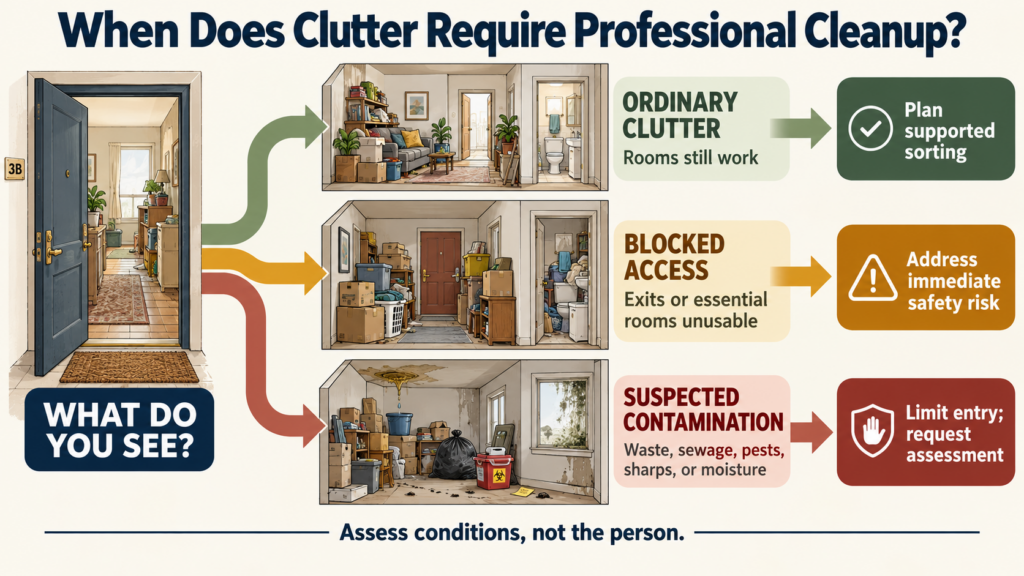
A practical triage guide
| What you observe | First priority | Typical help |
|---|---|---|
| Clutter, with working utilities and no known contamination | Agree on a manageable plan; preserve access | Organizer or ordinary cleanout service, with the occupant's participation |
| Blocked exit, unstable piles, unusable bathroom, or unsafe cooking area | Address immediate life-safety risk | Appropriate emergency or building-safety authority; coordinated support and cleanup |
| Waste, sewage, widespread rodent contamination, blood, or hidden sharps | Limit entry and prevent untrained sorting | Qualified remediation team; pest or specialty waste partners as needed |
| Water damage, visible mold, or persistent moisture | Stop the leak and assess affected materials | Water-damage or mold remediation professional |
| Odor after visible contents have been removed | Find the remaining source | Inspection and targeted remediation; rebuild only after affected materials are addressed |
The uncommon but important case: A packed, dry garage may be a severe fire and access problem without being a biohazard. A nearly empty room with sewage under its flooring may be a significant contamination job. Volume does not reliably measure exposure.
Also Read 👉🏻What Role Do Air Scrubbing, VOC Control, and CLO₂ Play in Meth Remediation?
What should you do before anyone starts removing items?
- Check for immediate danger. If someone needs urgent medical help or cannot exit safely, call emergency services. Keep other residents and staff away from the affected area.
- Do not disturb suspected contamination. Avoid dry sweeping rodent waste, opening unknown containers, handling loose sharps, or running fans through a contaminated area. Do not assume a mask and gloves make an untrained cleanout safe.
- Record the conditions without invading privacy. Note the date, location, blocked functions, odor, visible water or waste, and immediate hazards. Limit photos to those needed for the work, claim, or case record; handle them under your organization's privacy rules.
- Identify the decision maker and urgent needs. Determine who can authorize entry and work, whether the occupant needs a safe place during cleanup, and whether pets, children, or dependent adults need assistance. For a rental or institutional space, follow applicable access rules and organizational procedures.
- Arrange an assessment that can change the scope. Hidden conditions may become visible only after contents move. Ask for a written distinction between content handling, contaminated material removal, cleaning, odor work, pest control, moisture repair, and reconstruction.
Avoid treating the phrase “biohazard” as a verdict about the resident. It describes a possible exposure, not a person's identity or worth.
Cleanup options: which kind of help fits the problem?
Supported sorting and ordinary cleanout
When there is no suspected biological contamination or immediate structural hazard, a gradual sorting plan may be suitable. Establish priorities with the occupant: an accessible exit, a usable bathroom, a safe place to sleep, and working cooking space. Mark documents, medicines, photographs, and irreplaceable items for preservation. The International OCD Foundation encourages a harm-reduction approach that focuses on safer living conditions and respectful engagement rather than a surprise wholesale cleanout.
Pest control and source correction
Active pests need a control plan, entry-point repair, and removal of food and water sources. A pest contractor addresses the infestation; a remediation team addresses contaminated contents and surfaces. A plumber, roofer, or building maintenance professional may need to fix a leak before cleaning can last.
Professional biohazard or mold remediation
When waste, sewage, sharps, blood, extensive rodent contamination, or moisture-damaged materials are present, ask a qualified contractor to assess the site. The plan may include controlled access, appropriate protective equipment, separation of contents, removal of unsalvageable porous materials, cleaning and disinfection where appropriate, waste-stream management, and documentation. Methods should match the contaminant and surface; a single fogging, fragrance, or blanket spray is not a substitute for source removal. Denver Decon lists biohazard, mold, odor, and removal services for the metro Denver area.
Repairs and re-occupancy
Cleanup and reconstruction are different phases. A contractor may uncover damaged subflooring, drywall, plumbing, or electrical work that another trade must repair. Ask what is included in the remediation scope, how completion will be documented, and whether an independent assessment or clearance is appropriate for the specific hazard. Do not promise that a room is “sterile” or safe for every use based solely on a visual cleanout.
Also Read 👉🏻How Can Hidden Odors Destroy Property Value and Tenant Retention?
What does a professional hoarding-related cleanup look like?
Assessment and boundaries. The team identifies hazards, affected rooms, access routes, utilities, valuables, occupant priorities, and the likely order of work. A written estimate should state what can and cannot yet be seen.
A contents plan. The occupant or authorized decision maker helps define keep, review, and discard categories when feasible. Important records, mobility aids, medications, and sentimental items need a deliberate process. Contaminated items may not be salvageable, but the reason should be explained.
Controlled removal and remediation. Crews move from safe access to source removal and then to cleaning. They avoid spreading waste through shared hallways, elevators, HVAC pathways, or unaffected rooms. Waste is separated according to what it is and applicable local requirements; ordinary clutter does not automatically become regulated medical waste.
Verification and follow-through. The final walkthrough checks that contamination sources were addressed, essential spaces function, and unresolved repairs or pest issues are documented. A long-term plan may involve family support, a clinician, a case manager, building maintenance, or periodic follow-up. Cleaning changes the environment; it does not by itself treat hoarding disorder.
Guidance for families, social workers, landlords, and facility managers
Families: lead with safety and consent
Begin with a specific observation: “I’m worried the bathroom is blocked” is more useful than “You need to throw everything away.” Ask which items are essential and whether the person will take part in a small first step. If there is a serious immediate risk, seek appropriate local help. Avoid surprise disposal, publicizing photos, or promising that a single cleanout will solve the underlying difficulty.
Social workers and care teams: coordinate the human and property plans
Assess the person's immediate needs, capacity to participate, available supports, and any agency reporting duties under the circumstances. Pair safety goals with housing stability where possible. A remediation contractor can address environmental contamination; clinical treatment and social support belong with qualified care professionals. In Denver, the city's Human Services page provides a reporting route for suspected abuse or neglect of a child or at-risk adult; concerns outside Denver should go to the appropriate local agency.
Landlords and property managers: document conditions and scope
Describe observable hazards, not an assumed diagnosis. Follow applicable notice and entry requirements, protect other residents, coordinate shared-system issues, and establish who authorizes removal, storage, repairs, and payment. Ask the vendor to separate content disposal from remediation and reconstruction in its estimate. Coverage, responsibility, tenant rights, and enforcement depend on the lease, policy, facts, and local law; do not assume insurance or a “biohazard” label answers those questions.
Also Read 👉🏻Indoor Airborne Contaminants: Hidden Risks in Your Home & How to Eliminate Them
Facility managers: protect staff and adjacent spaces
Keep untrained custodial or maintenance workers from sorting suspected sharps or contaminated piles. Consider adjacent rooms, common areas, ventilation, accessible exits, and continuity of operations. Verify the contractor's relevant experience, worker-protection procedures, disposal plan, and documentation. If a school, healthcare facility, or other regulated setting is involved, follow its own incident, privacy, and occupational-safety protocols as well.
How much does cleanup cost, and how long does it take?
There is no useful universal price per room. The estimate depends on the quantity and location of contents, whether contamination is present, accessibility, labor and protective measures, waste streams, pest treatment, materials removed, odor source, and repairs. A small cleanout can be very different from multi-room remediation with damaged flooring and plumbing. Time likewise depends on what is found after safe access is created. Request a written scope, allowances for hidden conditions, and a process for approving changes before work proceeds.
If an insurance claim may apply, document the event and ask the insurer about the specific cause and coverage; chronic accumulation itself is not necessarily a covered loss. Denver Decon's biohazard cleanup cost guide explains why prices differ, but an on-site assessment is needed for a hoarding-related property.
Also Read 👉🏻How Is Meth Remediation Actually Performed in a Colorado Home?
Common myths that delay the right response
- “All hoarding is a biohazard.” No. Clutter can be dangerous through blocked access or fire load without biological contamination.
- “If there is no smell, it is safe.” No. Sharps, rodent residue, and hidden water damage may not announce themselves by odor.
- “A dumpster solves the problem.” It removes contents, but it does not necessarily remove absorbed contamination, repair the source, or support lasting change.
- “Everything must be thrown away.” Some uncontaminated belongings may be retained; a safe plan identifies what can be preserved and what cannot.
- “The cleanup crew can treat hoarding disorder.” Environmental remediation and mental health care have different roles. Coordinating them helps reduce repeat risk.
Frequently asked questions
Is hoarding itself a biohazard?
No. Hoarding conditions may create fire, fall, and access hazards without biological contamination. Biohazard concerns arise when waste, sewage, blood, rodent contamination, or similar materials are present or reasonably suspected.
What are the clearest signs that professional biohazard cleanup is needed?
Human or animal waste, sewage, blood-contaminated materials, widespread rodent droppings, hidden sharps, and contamination soaked into building materials are strong reasons to request a professional assessment.
Can a regular cleaning company handle a hoarded home?
Often yes when the job involves ordinary, uncontaminated contents. Suspected biological contamination or hidden sharps calls for a team with the right training, protective practices, and disposal plan.
Should I vacuum mouse droppings before the cleanup crew arrives?
No. The CDC advises against sweeping or vacuuming rodent urine, droppings, or nests before they have been disinfected. Leave a heavy or inaccessible infestation to qualified help.
Does a strong odor prove the home is contaminated?
No. Odor signals that a source should be investigated, but it does not identify that source or measure exposure. A home may also have hazards with little noticeable smell.
Can belongings be saved during biohazard cleanup?
Some can. Salvage depends on the contaminant, how long the item was affected, its material, and whether it can be cleaned safely. Ask for a review and preservation plan before disposal begins.
Do you have to remove carpet or drywall?
Only when an assessment shows that affected material cannot be adequately cleaned or dried. Sewage, persistent moisture, and contamination absorbed into porous materials can make removal necessary.
How can family members help without making the situation worse?
Focus on immediate safety, ask for the resident's participation, preserve important belongings, and involve professional care or case support when appropriate. Avoid surprise mass disposal unless an immediate emergency requires action.
What should a landlord or property manager document?
Record observable conditions, dates, access issues, maintenance concerns, vendor findings, authorizations, work scopes, and completion records. Follow the applicable lease and local requirements when entering or arranging work.
Will insurance pay for hoarding or biohazard cleanup?
Coverage depends on the policy and cause of loss. Document the event, ask the insurer about the specific claim, and request an itemized remediation scope. Do not assume a hoarding cleanout is covered merely because contamination is present.

What should you do next?
If you are looking at a home, apartment, or facility and wondering whether it has crossed the line from difficult to dangerous, start with the hazards you can name: a blocked exit, unusable bathroom, active pests, waste, moisture, or a contaminated surface. Protect the person and everyone who may enter. Then seek an assessment that matches the actual conditions and preserves the resident's dignity.
Denver Decon serves the Denver metro area with biohazard, mold, and odor remediation services. Contact DenverDecon to describe the site and request the appropriate next step. You do not need to know the technical name of the contamination before making the call. A clear description of what you have seen is enough to begin a safer plan.
Editorial note: This article gives general safety and service guidance. Confirm legal duties, waste classification, access rights, and insurance coverage for the specific site and jurisdiction.