

The Hidden Toxicity of Meth Residue in Homes
When people hear the term meth house, they often imagine a crime scene or a hazardous laboratory. The reality is more subtle—and in some ways more concerning.
Methamphetamine contamination doesn’t disappear when the occupants leave. In fact, the toxic residues created during meth use or production can remain embedded in building materials, furniture, ventilation systems, and household dust for months or even years.
Those residues contain a mixture of chemicals including:
• Methamphetamine particles
• Solvents used during production
• Acids and bases
• Heavy metals
• Combustion byproducts
Together, these contaminants create a persistent toxic environment that can affect anyone living in the home—even if they never used drugs themselves.
For homeowners, renters, landlords, and real estate professionals, understanding the health science behind meth contamination is critical.
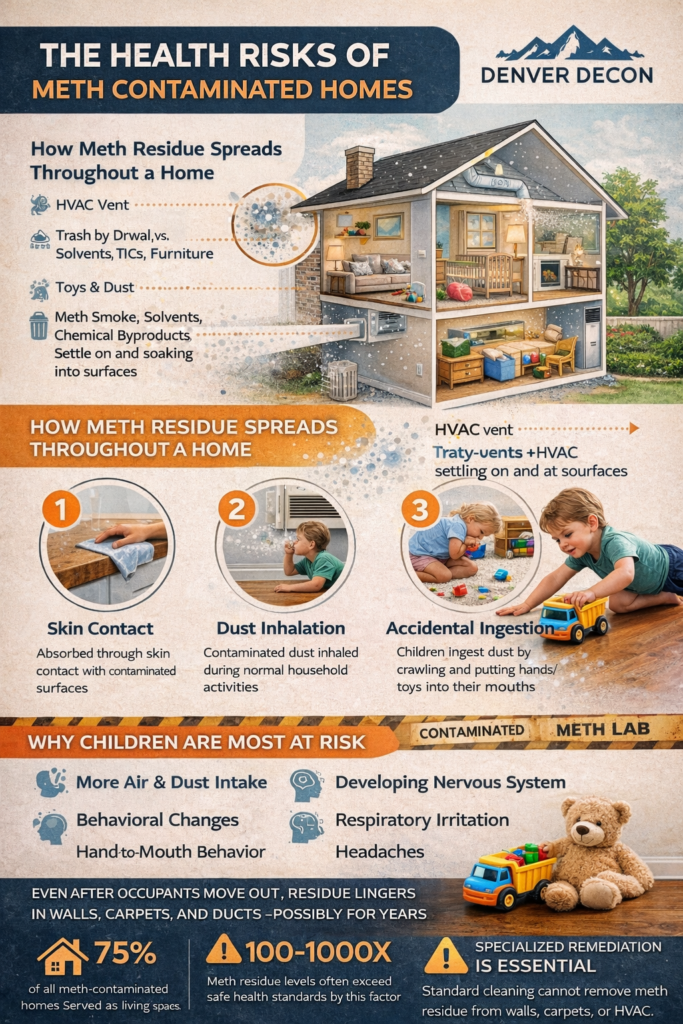
How Meth Residue Spreads Throughout a Home
Meth residue behaves more like fine chemical dust than a visible stain.
When meth is smoked or produced, microscopic particles disperse through the air and settle onto nearly every surface.
Common contamination points include:
• Walls and ceilings
• Carpets and upholstery
• HVAC systems and ductwork
• Curtains and bedding
• Kitchen surfaces
• Children's toys
• Porous materials like drywall and insulation
Over time, these residues migrate deeper into porous materials and can even re-emit into the air, a process known as off-gassing.
This means contamination can continue affecting indoor air quality long after the original drug activity has stopped.
In practical terms, a home can appear perfectly clean while still containing measurable levels of meth residue.
The Three Primary Exposure Pathways

People living in a contaminated home are exposed to meth residue through three main pathways.
1. Skin Contact (Dermal Absorption)
Methamphetamine is readily absorbed through the skin.
Contact with contaminated surfaces—such as countertops, bedding, or floors—can allow the drug and associated chemicals to enter the body directly through the skin.
For individuals who spend extended time indoors, this exposure can accumulate over time.
2. Inhalation of Contaminated Dust
Residues often bind to dust particles.
Normal household activity—walking across carpets, sitting on furniture, turning on heating or air conditioning—can stir contaminated dust into the air where it can be inhaled.
Once inhaled, these particles may irritate the respiratory system and introduce methamphetamine and other chemicals into the bloodstream.
3. Accidental Ingestion
Small children are especially vulnerable because of natural behaviors such as:
• Crawling on floors
• Putting hands or toys in their mouths
• Frequent contact with household surfaces
Contaminated dust on hands or objects can easily be ingested, resulting in higher internal exposure levels compared to adults.
Why Children Are the Most Vulnerable
Children face significantly higher risks from environmental toxins, and meth contamination is no exception.
Several biological and behavioral factors amplify the danger:
Higher intake relative to body weight
Children breathe more air and consume more food and water per pound of body weight than adults.
Developing organs and nervous systems
Their brains, lungs, and immune systems are still developing, making them more sensitive to toxic chemicals.
Close contact with surfaces
Crawling, playing on floors, and touching objects increases exposure.
Hand-to-mouth behavior
This behavior dramatically increases the likelihood of ingesting contaminated dust.
Studies of children living in meth-contaminated homes have documented symptoms including:
• Behavioral changes
• Hyperactivity
• Sleep disturbances
• Respiratory irritation
• Headaches
• Nausea
Because symptoms can resemble common childhood illnesses, exposure often goes unrecognized.
Meth Residue Exposure Symptoms in Adults

Adults living in contaminated homes may also experience health effects.
Commonly reported symptoms include:
• Persistent headaches
• Irritated eyes and throat
• Respiratory discomfort
• Skin irritation or rashes
• Fatigue
• Mood or cognitive changes
These symptoms can be subtle and may worsen with prolonged exposure.
In many cases, occupants do not realize their living environment is the source of the problem.
Long-Term Exposure Concerns
Long-term exposure to methamphetamine residues is still an emerging area of environmental health research.
However, scientists understand that chronic exposure to low levels of stimulants and associated chemical byproducts may affect:
• Neurological function
• Hormonal balance
• Respiratory health
• Immune response
Methamphetamine itself is a powerful central nervous system stimulant. Even small amounts absorbed repeatedly over time may produce physiological effects, particularly in sensitive populations.
The concern grows when contamination includes additional chemicals used during meth production, many of which are known irritants or toxic compounds.
Why Meth Contamination Persists After Occupants Leave

One of the most dangerous myths about meth houses is that contamination disappears once the drug activity stops.
Unfortunately, meth residue is chemically sticky.
It adheres strongly to porous materials such as:
• Drywall
• Wood
• Fabrics
• Carpets
• Insulation
Standard cleaning methods rarely remove it effectively.
In fact, attempts to clean a contaminated property using conventional household cleaners may simply spread residues further across surfaces.
Heating systems and air movement can also redistribute contamination throughout the home.
Because of this persistence, contaminated homes often require professional testing and specialized remediation to return them to safe occupancy levels.
Meth Contamination Is a Public Health Issue
Meth contamination is not simply a legal or regulatory concern.
It is fundamentally a public health problem.
Families unknowingly moving into contaminated properties can face prolonged exposure to harmful chemicals. Landlords and property managers may also face liability if contamination is not properly addressed before re-occupancy.
Recognizing the health risks is the first step toward preventing long-term exposure.
Professional Remediation Protects Occupants and Property
Proper remediation of a meth-contaminated home involves more than surface cleaning.
Professional decontamination specialists use scientific testing and specialized cleaning techniques to remove residues from affected materials and prevent re-contamination.
This process typically includes:
• Detailed contamination assessment
• Surface and air testing
• Removal of heavily contaminated materials
• Deep chemical cleaning of structural surfaces
• HVAC system decontamination
• Post-remediation verification testing
For property owners and families, professional remediation restores not only compliance with safety standards—but also peace of mind.
Protecting Health Through Proper Meth Decontamination
The invisible nature of meth contamination makes it particularly dangerous. Without testing and remediation, occupants may unknowingly live in an environment containing toxic residues.
Understanding how contamination spreads, how exposure occurs, and why children are especially vulnerable highlights the importance of addressing these properties with proper scientific remediation methods.
For communities, homeowners, and property managers, addressing meth contamination is not simply about meeting regulations—it is about protecting human health.
(FAQs)
1. What are the health risks of living in a meth-contaminated home?
Exposure can cause respiratory irritation, headaches, behavioral changes, skin irritation, and neurological symptoms. Children are especially vulnerable because they ingest more contaminated dust and have developing organ systems.
2. How does meth residue spread in a house?
Meth residue spreads through airborne particles created during smoking or production. These particles settle on surfaces, bind to dust, and can circulate through HVAC systems.
3. Can meth contamination affect people years later?
Yes. Meth residue can persist for years in porous materials such as drywall, carpets, and insulation if a home is not professionally remediated.
4. Why are children more affected by meth contamination?
Children crawl on floors, put objects in their mouths, and breathe more air relative to their body weight, increasing their exposure to contaminated dust and surfaces.
5. What symptoms suggest meth residue exposure?
Common symptoms include headaches, respiratory irritation, nausea, fatigue, sleep problems, and behavioral changes.
6. Can normal cleaning remove meth contamination?
No. Standard cleaning methods rarely remove meth residues completely and may spread contamination further.
7. Is meth contamination only dangerous in former meth labs?
No. Residue can accumulate from repeated smoking of methamphetamine, meaning homes where drugs were used—not just manufactured—can become contaminated.
8. How is meth contamination tested?
Professional testing involves collecting surface wipe samples and analyzing them in laboratories to measure meth residue levels.
9. What is meth remediation?
Meth remediation is the specialized process of removing meth residues and contaminated materials to restore a property to safe occupancy levels.
10. Can a contaminated home be made safe again?
Yes. With proper testing and professional remediation, meth-contaminated homes can be restored to safe living conditions.