
A positive methamphetamine test can turn an ordinary property decision into an urgent, unfamiliar problem. Homeowners may worry about their family’s exposure. Landlords may have tenants, lease obligations, and a vacant unit to manage. Buyers, sellers, and real estate professionals may suddenly face questions about habitability, disclosure, financing, and property value.
The most important thing to understand is that a positive result is not the end of the property. It is the beginning of a regulated process for defining the affected area, removing contamination, verifying the results, and documenting that the property meets Colorado’s requirements.
Colorado treats properties contaminated by methamphetamine manufacturing, use, storage, processing, or disposal as methamphetamine-affected properties. That distinction matters: a property does not need to have contained a traditional clandestine “meth lab” to become contaminated. Repeated smoking or other meth use can leave residue on walls, ceilings, floors, furnishings, ventilation components, and other surfaces.
If your Colorado property has tested positive, avoid improvised cleaning, demolition, or painting. Preserve the test results, limit unnecessary access, and begin working with qualified professionals who understand Colorado’s assessment, decontamination, clearance, and documentation requirements.
Also Read 👉🏻How Do Buyers Discover Meth Contamination During Home Inspections?
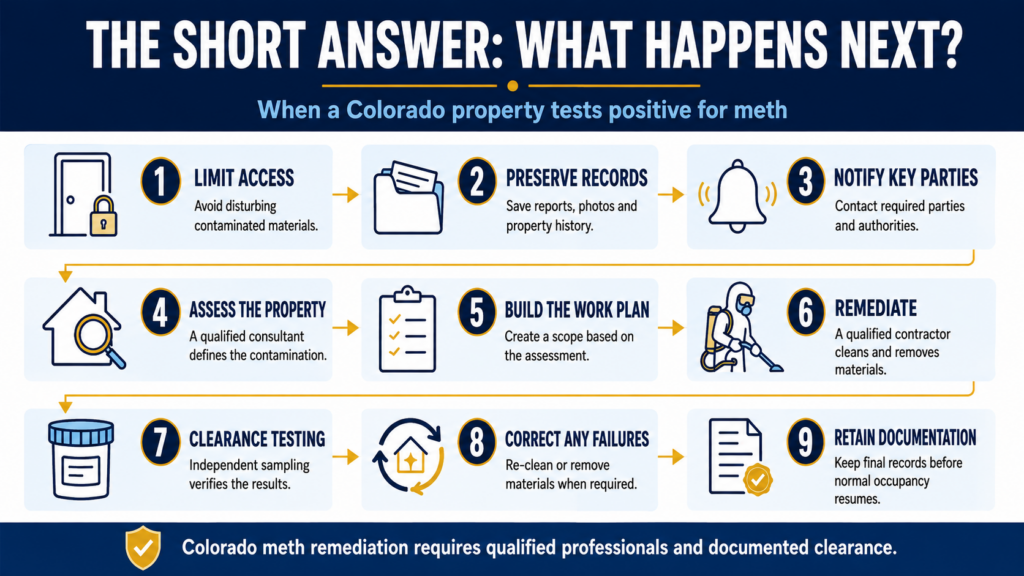
The Short Answer: What Happens Next?
After a Colorado property receives a confirmed positive meth result, the typical path is:
Limit access and avoid disturbing potentially contaminated materials.
Preserve the laboratory report, sampling plan, photographs, and property history.
Notify the appropriate parties and governing authority as required for the situation.
Retain a qualified consultant to assess the property and define the contamination.
Develop a decontamination scope or work plan based on the assessment.
Have a Colorado-qualified contractor perform remediation and necessary material removal.
Complete independent clearance sampling.
Re-clean or remove materials if any clearance result remains above the applicable standard.
Obtain and retain the final documentation before normal occupancy resumes.
The exact sequence can vary with the property, how the initial test was collected, the governing jurisdiction, and whether law enforcement or a public agency is involved. A screening result answers an important question—whether meth residue was detected—but it may not define every affected room, surface, or system.
Also Read 👉🏻What Are the Health Risks of Living in a Meth-Contaminated Home?
Step 1: Treat the Result Seriously, but Do Not Panic
Meth residue is generally invisible. A property can look clean, smell normal, and still produce a positive surface sample. Conversely, a positive sample from one location does not automatically establish that every part of the structure is contaminated to the same degree.
Your first job is to prevent avoidable exposure and cross-contamination while the result is evaluated. Do not sand walls, tear out carpet, operate contaminated equipment, move belongings from the affected area into a clean location, or begin aggressive cleaning. Those actions may spread residue or make the eventual assessment more complicated.
If occupants report symptoms or you have an immediate medical concern, contact an appropriate healthcare professional or emergency service. A remediation contractor can address the building, but cannot diagnose whether a particular symptom was caused by methamphetamine exposure.
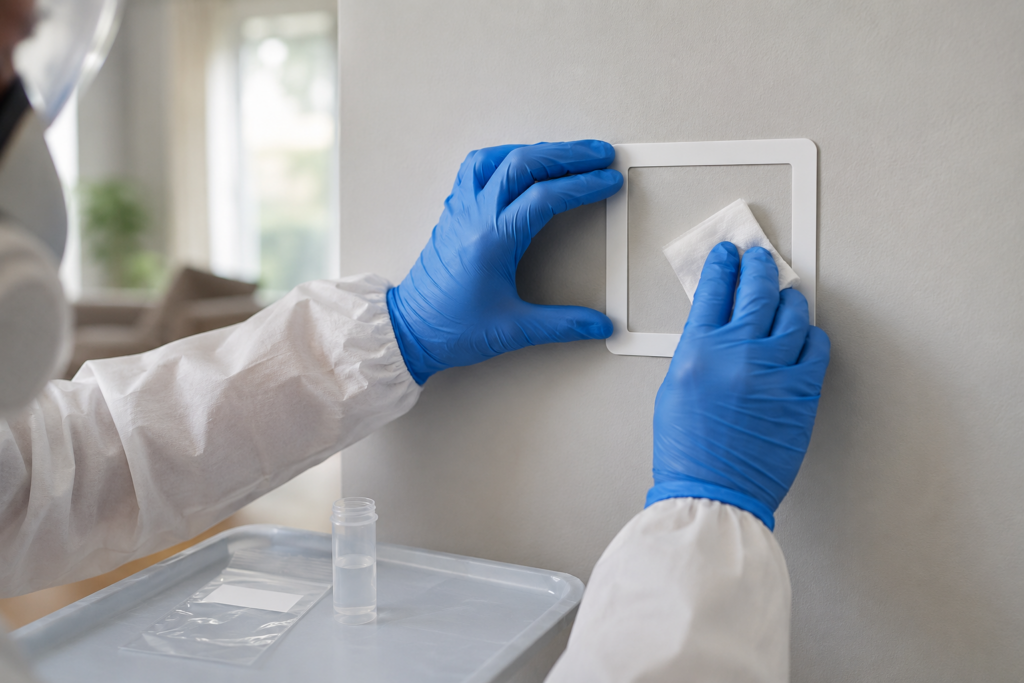
Step 2: Confirm What the Test Actually Shows
Not all meth tests provide the same quality of information. Before major decisions are made, review:
who collected the sample and whether that person was properly qualified for the intended purpose;
whether the sample was a field screening test or analyzed by a laboratory;
whether it was a discrete sample from one location or a composite made from several locations;
the surface area sampled and the units used in the report;
the precise rooms and surfaces included;
the chain-of-custody documentation; and
any blanks, controls, photographs, diagrams, or sampling notes.
A properly documented result helps the consultant understand what is known, what remains uncertain, and what additional assessment may be needed. A home test kit or limited screening result should not be stretched beyond what it can reliably establish.
Step 3: Restrict Access and Protect Unaffected Areas
Limiting access is not an admission that the entire building is unsafe. It is a practical measure to keep people from contacting or spreading residue until the affected area is defined.
Depending on the property, sensible precautions may include securing the area, stopping renovation work, avoiding the movement of porous belongings, and preventing untrained cleaners or maintenance personnel from entering. In apartments, condominiums, hotels, or buildings with shared hallways, controlling dust and air movement is particularly important.
Colorado’s decontamination procedures require negative-air equipment with HEPA filtration during decontamination in multi-unit buildings and buildings with common access hallways. This is designed to reduce the dispersal of airborne particles created by remediation work.
Step 4: Notify the Right People and Governing Authority
The required notifications depend on the facts. A homeowner, landlord, seller, property manager, employer, insurer, lender, buyer, or governing body may each have a legitimate role. Local public-health or building authorities may administer parts of the process.
Do not conceal the result or make casual statements about safety before the result has been professionally evaluated. At the same time, avoid speculation. Communicate the known facts: what was tested, where it was tested, what the laboratory reported, and what qualified professionals are being retained to determine the next steps.
Because disclosure, lease, insurance, employment, and real-estate obligations can be fact-specific, obtain advice from the appropriate attorney, insurer, or public authority when those issues arise. A cleanup company should not substitute for legal advice.
Step 5: A Qualified Consultant Defines the Problem
Colorado’s system separates important professional roles. A qualified consultant assesses the property, interprets sampling data, helps establish the affected area, and performs or oversees clearance sampling. A certified decontamination contractor performs the cleanup and removal work under the required supervision.
That separation protects the integrity of the final decision. The contractor’s job is to remediate the property. The consultant’s clearance work provides independent evidence about whether the applicable cleanup criteria have been achieved.
The assessment may consider:
known or suspected locations of meth use or manufacturing;
the original sample locations and results;
room layout and pathways between areas;
shared walls, hallways, attics, and crawl spaces;
heating, ventilation, and air-conditioning systems;
porous and nonporous materials;
personal property and major appliances;
signs of chemical storage, staining, dumping, or waste; and
adjacent units or common spaces when migration is plausible.
The goal is not to generate the most demolition possible. It is to define a defensible scope that removes the contamination and protects future occupants without performing unnecessary work.
Step 6: A Remediation Plan Is Developed
Once the affected area is understood, the project can be translated into a work plan. The scope should identify what will be cleaned, what must be removed, how workers and unaffected areas will be protected, how waste and wash water will be managed, how ventilation components will be addressed, and how the property will be prepared for clearance sampling.
Colorado rules emphasize physical removal of contamination. They prohibit relying on products that merely chemically treat or alter contaminants instead of physically removing them. Typical regulated procedures can include HEPA vacuuming where visible dust is present, detergent washing, potable-water rinsing, controlled removal of materials that cannot be successfully decontaminated, and specialized work on ventilation systems.
Every project is different. A lightly affected nonporous surface may be cleanable. Carpet, insulation, flexible ducting, or compromised porous materials may require removal. The decision should be driven by the assessment, the material, the contamination level, Colorado requirements, and the ability to prove compliance through clearance sampling.
Step 7: Certified Meth Remediation Begins
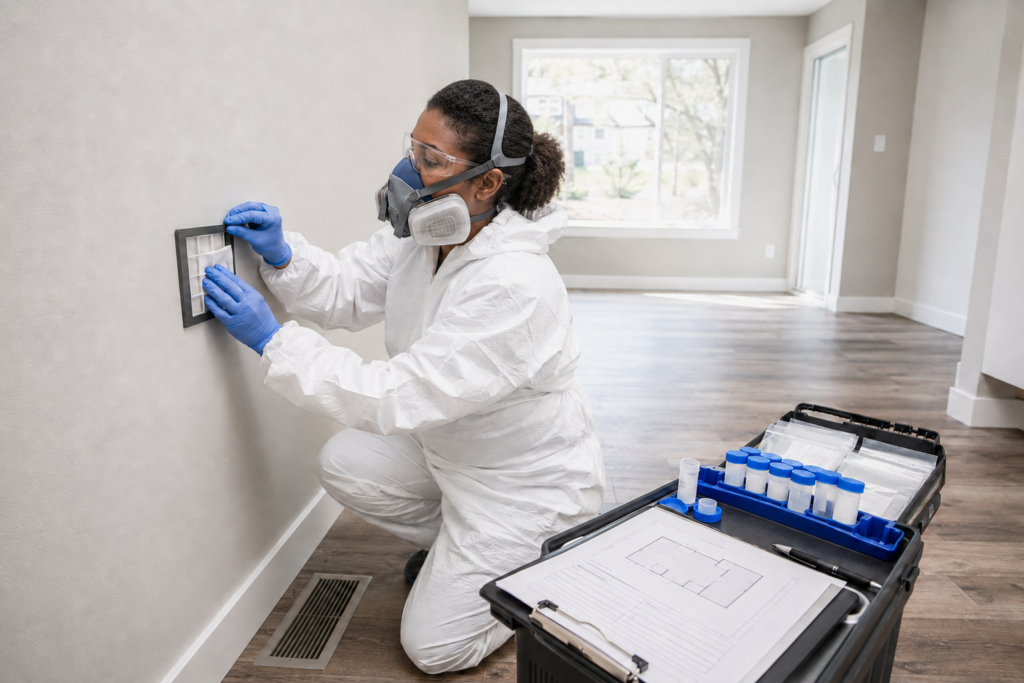
Meth remediation is not ordinary housekeeping. Colorado requires decontamination and removal of contaminated materials to be performed by a contractor in good standing and overseen by a decontamination supervisor. Workers use appropriate personal protective equipment and controlled procedures intended to protect workers, occupants, neighbors, and the public.
A professional project may involve:
establishing containment and controlling access;
protecting clean areas from cross-contamination;
removing and disposing of materials that cannot be adequately decontaminated;
HEPA vacuuming dust and particulate matter;
repeatedly washing and rinsing affected surfaces;
managing contaminated debris and wash water;
addressing attics, crawl spaces, plumbing, or personal property when applicable;
decontaminating or removing affected ventilation components; and
photographing and documenting completed work.
Denver Decon provides professional meth-lab decontamination and remediation services for Denver and Colorado property owners. The value of an experienced contractor is not simply labor. It is the ability to coordinate a controlled scope, follow the applicable procedures, anticipate difficult materials and building systems, and prepare the property for a defensible clearance decision.
Also Read 👉🏻How Do You Know If a Cleanup Company Is Actually Qualified?
Does Painting Over Meth Contamination Make a Property Safe?
No—not by itself. Painting over a contaminated wall is not the same as removing meth residue, and paint cannot be used as a shortcut around Colorado’s decontamination and clearance requirements.
Colorado’s rules state that decontamination must use techniques that physically remove contamination. They also provide that encapsulation may occur only after clearance sampling has demonstrated that the cleanup standard has been achieved, subject to the governing body’s requirements.
The rule contains a narrow provision for surfaces that had already been painted over. Following decontamination, a painted-over surface that falls within the regulatory range identified for those surfaces must be encapsulated or removed. When encapsulation is required under that provision, the rule specifies a spray-applied coat of oil-based paint. Painted-over surfaces that have been decontaminated below the general cleanup standard do not have to be encapsulated.
The order of operations is the critical point:
Assess: Define the contamination before disturbing the surface.
Decontaminate: Use physical removal procedures required for the material and project.
Verify: Perform clearance sampling after decontamination.
Encapsulate only when allowed: Apply encapsulation only when the rule permits or requires it after the preceding steps.
Simply rolling new paint over a positive wall before professional assessment can create additional cost and complexity. It may hide the original surface, interfere with the investigation, and produce a painted-over surface that must be handled under the regulation’s special criteria.
Property owners, painters, maintenance teams, and real estate investors should review Colorado’s decontamination and removal procedures under 6 CCR 1014-3-1-5.0 and obtain project-specific direction before coating, demolishing, or disturbing a positive surface.
Step 8: The HVAC System and Hidden Areas Are Addressed
One of the easiest mistakes is focusing only on visible room surfaces. Air-handling equipment can collect and redistribute dust, and some buildings use wall cavities or other structural spaces as air pathways.
Colorado’s rule contains detailed ventilation procedures. Depending on the system and assessment, porous components, flexible ducting, glass-lined ducting, or damaged components may have to be removed. Remaining components may require inspection, controlled HEPA vacuuming, agitation, cleaning under negative pressure, and documentation.
Attics and crawl spaces also require special attention when testing shows contamination above the applicable limited-exposure standard. Insulation, vapor barriers, debris, ducting, or even contaminated soil may become part of the scope. These areas should not be treated as afterthoughts; a property cannot receive a reliable clearance simply by cleaning its most accessible rooms.
Step 9: Independent Clearance Sampling Determines Whether Cleanup Worked
Remediation is not complete because a surface looks clean or because the contractor has finished washing. Clearance sampling is the evidence-based checkpoint.
Colorado’s general methamphetamine cleanup standard is 0.5 micrograms per 100 square centimeters for a sample, with different limits applying to specified limited-exposure areas and qualifying painted-over surfaces. The consultant determines the proper sampling strategy and interprets the results under the current rule.
If a material or area fails clearance, it must be cleaned again or removed and properly disposed of. Additional clearance sampling is then necessary. This cycle continues until contaminated material has been removed or the applicable standard has been met.
This is why an unrealistically low estimate can be misleading. A sound project must account not only for initial cleaning, but also for the building systems, difficult materials, waste handling, documentation, and the possibility that an area will require additional work after testing.
Step 10: The Property Receives Final Documentation
The final records matter long after the equipment leaves. A complete project file may include:
the original laboratory report and sampling records;
the consultant’s assessment and work-plan documentation;
contractor certifications and project scope;
photographs taken before, during, and after remediation;
records of removed materials and waste handling;
change orders or explanations for altered scope;
ventilation-system documentation;
clearance sampling locations and laboratory results; and
final reports or notices required by the governing authority.
These records help future buyers, tenants, property managers, lenders, insurers, and public agencies understand what happened and how the property was restored. Keep them with the property’s permanent records rather than treating them like an ordinary cleaning invoice.
Also Read 👉🏻What Role Do Air Scrubbing, VOC Control, and CLO₂ Play in Meth Remediation?
How Long Does the Process Take?
There is no honest one-size-fits-all schedule. Timing is influenced by the size and type of property, the quality of the initial testing, the number of affected rooms, contamination levels, personal property, HVAC configuration, the availability of the consultant and laboratory, material removal, local approvals, and whether the first round of clearance samples passes.
A small, well-defined project may move relatively quickly. A heavily contaminated home, multi-unit building, former manufacturing site, or property with affected ventilation and porous materials can require a more extensive assessment and remediation process.
The fastest responsible approach is to assemble the right team early, preserve good records, avoid unapproved work, and make decisions from reliable sampling rather than guesswork.
Who Pays for Meth Remediation?
Responsibility can depend on ownership, lease terms, insurance coverage, contracts, the history of contamination, and applicable law. Property owners should promptly notify their insurer when coverage may exist, but they should not assume a claim will be covered or denied until the policy and facts are reviewed.
Landlords, buyers, sellers, investors, and property managers may also need legal advice regarding contracts, disclosure, habitability, tenant relocation, damages, or recovery from a responsible party. Remediation documentation can become important evidence in those discussions, which is another reason not to begin undocumented demolition or cleaning.
👀IAQ Testing Services
Common Mistakes After a Positive Meth Test
Cleaning before the assessment
Early cleaning can spread residue or erase information that would help define the source and extent of contamination.
Assuming only the sampled spot matters
A single positive location may be part of a larger affected area. The building layout, history, airflow, and nearby materials must be considered.
Hiring an ordinary cleaning or painting company
Meth remediation involves regulated roles, worker protections, waste handling, controlled decontamination, and clearance—not cosmetic cleaning.
Moving belongings into a clean building
Porous or dusty contents can carry residue into a vehicle, storage unit, or replacement residence. Personal property should be evaluated before it is relocated.
Treating paint as the cleanup
Colorado restricts encapsulation and makes clearance central to the process. New paint alone does not establish compliance.
Accepting “looks clean” as proof
Appearance and odor do not establish whether a surface meets the applicable numerical standard. Laboratory-based clearance sampling does.
Choosing a contractor on price alone
Compare qualifications, scope, containment, HVAC treatment, material assumptions, waste management, documentation, and responsibility for failed clearance—not merely the initial total.
Also Read 👉🏻How Can Hidden Odors Destroy Property Value and Tenant Retention?
Frequently Asked Questions About Meth-Contaminated Properties in Colorado
4. Can I clean meth contamination myself?
No. A meth-contaminated property should not be treated like an ordinary cleaning project. Colorado requires regulated decontamination work to be performed by qualified contractors using approved procedures, worker protections, containment, waste-management practices, and clearance testing.
5. Does painting over meth contamination make a property safe?
No. Paint does not physically remove methamphetamine residue and cannot be used as a shortcut around decontamination. Colorado restricts encapsulation to specific post-decontamination circumstances after clearance sampling has demonstrated compliance with the applicable requirements.
6. What is the Colorado cleanup standard for methamphetamine?
Colorado’s general methamphetamine cleanup standard is 0.5 micrograms per 100 square centimeters for a sample. Different limits apply to certain limited-exposure areas and qualifying paintever surfaces, so results should be interpreted by a properly qualified consultant under the current regulations.
7. What happens during professional meth remediation?
Professional remediation may include controlled access, containment, HEPA vacuuming, detergent washing and rinsing, removal of materials that cannot be successfully decontaminated, HVAC-system treatment, waste management, project documentation, and preparation for independent clearance sampling.
8. Can meth contamination spread through an HVAC system?
Yes. Air-handling systems can collect and redistribute contaminated dust. Depending on the assessment, porous or damaged components may require removal, while other components may require controlled cleaning, HEPA vacuuming, agitation, negative pressure, inspection, and documentation.
9. What happens if the property fails clearance testing?
An area or material that fails clearance must be decontaminated again or removed and properly disposed of. Clearance sampling is then repeated. The process continues until the contaminated material has been removed or the applicable cleanup requirement has been met.
10. Can a remediated meth property be safe to occupy again?
Yes. Many affected properties can be restored for occupancy when the contamination is properly assessed, remediated under Colorado requirements, and verified through independent clearance sampling. Owners should retain all assessment, remediation, laboratory, and final clearance documentation.
11. Does a positive meth test mean the property must be demolished?
No. Many affected properties can be successfully remediated. Demolition or selective removal may be necessary when materials cannot be brought into compliance, when contamination is extensive, or when the owner chooses removal instead of decontamination. The assessment and remediation plan should determine what is justified.
12. Can meth smoking contaminate a property even if meth was never manufactured there?
Yes. Colorado’s methamphetamine-affected-property framework covers contamination associated with meth use as well as manufacturing, processing, storage, and disposal. Residue from smoking can accumulate on indoor surfaces and building components.
13. Can occupants remain in the property during remediation?
Access decisions should be made with the consultant, contractor, governing authority, property owner, and—when appropriate—a healthcare professional. Remediation areas must be controlled, and occupancy may be restricted depending on the extent and location of contamination.
14. Can I use a home test kit to prove the property is safe?
A screening kit may indicate that meth residue is present, but it is not a substitute for the assessment and documented clearance process required for a regulated property. Final decisions should rely on properly collected and interpreted samples.
15. What happens if the property fails clearance testing?
The failed area or material must be decontaminated again or removed and properly disposed of. Clearance sampling is repeated until the applicable requirement is met.
16. Should I paint before the consultant samples the property?
No. Do not paint, sand, demolish, or otherwise disturb suspected surfaces before receiving project-specific direction. Painting can complicate sampling and does not eliminate the need for decontamination.
17. Is the contractor the same person who provides final clearance?
Colorado distinguishes between the contractor performing decontamination and the qualified consultant responsible for assessment and clearance functions. That separation supports an independent determination of whether the cleanup criteria have been achieved.
What You Should Do Next. . .
A Positive Test Is a Problem With a Defined Path Forward
Finding meth contamination in a home, rental, commercial building, or investment property is frustrating and unsettling. The uncertainty often feels worse than the residue itself: Which rooms are affected? Can the building be saved? What must be removed? How much will it cost? When can people safely return?
Those questions should not be answered with guesswork, cosmetic paint, or unnecessary demolition. Colorado provides a structured path: understand the test, control access, define the affected area, physically remove contamination, address hidden systems and difficult materials, and verify the result through independent clearance sampling.
Acting promptly matters because unapproved cleaning, renovation, or movement of belongings can spread contamination and complicate the project. Urgency, however, should not become panic. The goal is a defensible restoration plan that does the work the property actually needs—no shortcuts, no unsupported promises, and no unnecessary services.
Denver Decon helps Colorado property owners navigate that process with trained remediation professionals, controlled decontamination procedures, and clear project coordination. If your property has tested positive—or you have credible reason to suspect meth contamination—contact Denver Decon to discuss the result and identify the appropriate next step toward a clean, documented, usable property and lasting peace of mind.