
When someone dies alone and is not discovered immediately, families and property owners are often left facing two very different problems at the same time.
The first is personal: someone has died.
The second is practical: what happens to the home now?
One of the first questions people understandably ask is:
How long does it take to clean up after an unattended death?
There is no universal timeline. A relatively contained unattended-death scene may sometimes be remediated within a day, while a more complicated scene involving decomposition, contaminated flooring, subflooring, drywall, furnishings, personal belongings, or persistent odor can take several days or longer.
The more useful question is not simply, "How many hours will cleanup take?"
It is:
How far did the contamination travel, what materials did it affect, and what must be removed or remediated before the affected area can be considered properly addressed?
For families, landlords, property managers, and property owners in Denver and throughout Colorado, that distinction is especially important because unattended-death cleanup can involve both federal worker-safety requirements and Colorado-specific medical-waste regulations.
Also Read 📖What Are the Health Risks of Living in a Meth-Contaminated Home?
The Short Answer: How Long Does Unattended Death Cleanup Take?
As a general planning framework, unattended-death cleanup may fall into ranges such as:
- Limited contamination: several hours to approximately one working day
- Moderate contamination: approximately one to several days
- Extensive decomposition or structural contamination: several days or potentially longer
- Cleanup requiring substantial demolition, contents processing, odor remediation, or reconstruction: the entire restoration process may extend beyond the biohazard-cleanup phase
These are estimates, not guarantees.
A professional company should be cautious about promising an exact completion time before evaluating the property.
Two rooms of identical size can require dramatically different amounts of work.
The reason is simple:
The size of the room does not determine the scope of an unattended-death cleanup. The extent and pathway of contamination do.
What Is an Unattended Death?
An unattended death generally describes a situation in which a person dies without another person present and is not discovered for some period of time.
An unattended death may result from:
- Natural causes
- A medical emergency
- An accident
- Suicide
- Homicide
- An individual living alone
- A welfare-check situation
- Other circumstances in which death is not immediately discovered
"Unattended" does not necessarily mean that the person was neglected.
It describes the circumstances surrounding the death and discovery.
Once a person dies, normal postmortem biological processes begin. If enough time passes before discovery, decomposition can result in biological fluids and other material affecting the surrounding environment.
That is when an unattended death can become not only a difficult personal event but also a specialized remediation problem.
Why Does an Unattended Death Require Specialized Cleanup?
A common misconception is that unattended-death cleanup is essentially an extreme version of ordinary house cleaning.
It is not.
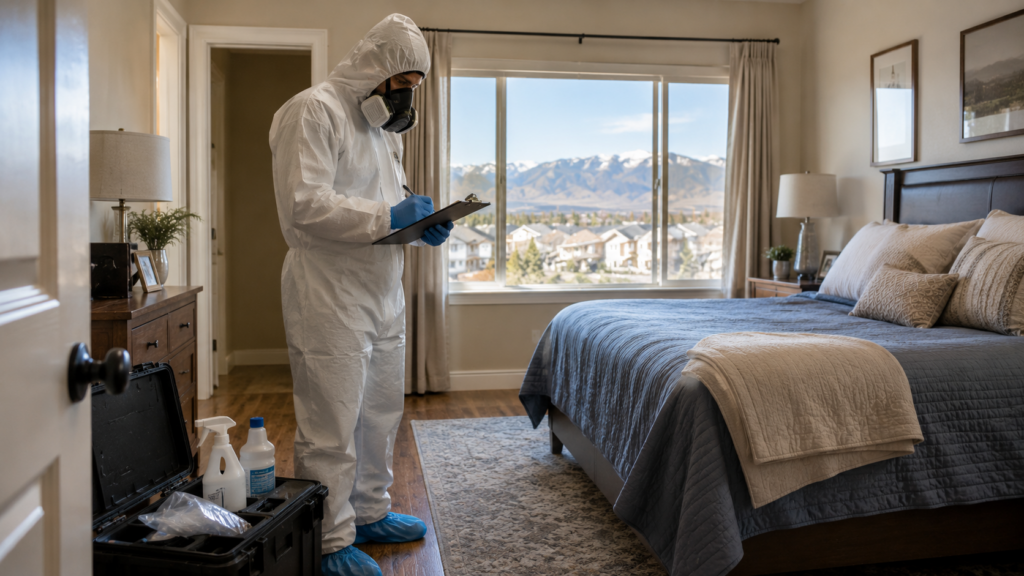
Decomposition can affect both visible and concealed materials. Depending on the circumstances, contamination may involve:
- Carpet
- Carpet padding
- Hardwood or laminate flooring
- Subflooring
- Concrete
- Baseboards
- Drywall
- Insulation
- Mattresses
- Bedding
- Upholstered furniture
- Clothing
- Personal belongings
- Cleaning materials used at the scene
Colorado's regulations provide unusually useful context here.
Under 6 CCR 1007-2, Colorado defines "trauma scene waste" as waste generated during decontamination of accident scenes, crime scenes, suicides, and other scenes involving serious human injury or death.
The state's definition specifically includes potentially contaminated flooring, furniture, drywall, clothing, bedding, cleaning solutions, PPE, wipes, absorbents, and sharps. Colorado also includes trauma-scene cleanup sites within its definition of medical-waste generators.
That regulatory definition illustrates an important point:
A death scene is not necessarily contaminated only where the body was located.
The affected environment may extend into building materials and contents surrounding that location.
Colorado Guideline: Medical and Trauma-Scene Waste
Colorado's medical-waste requirements are administered through the Colorado Department of Public Health and Environment's Hazardous Materials and Waste Management Division.
Colorado Department of Public Health and Environment — Medical Waste Regulations
Colorado Code of Regulations — 6 CCR 1007-2, Part 1
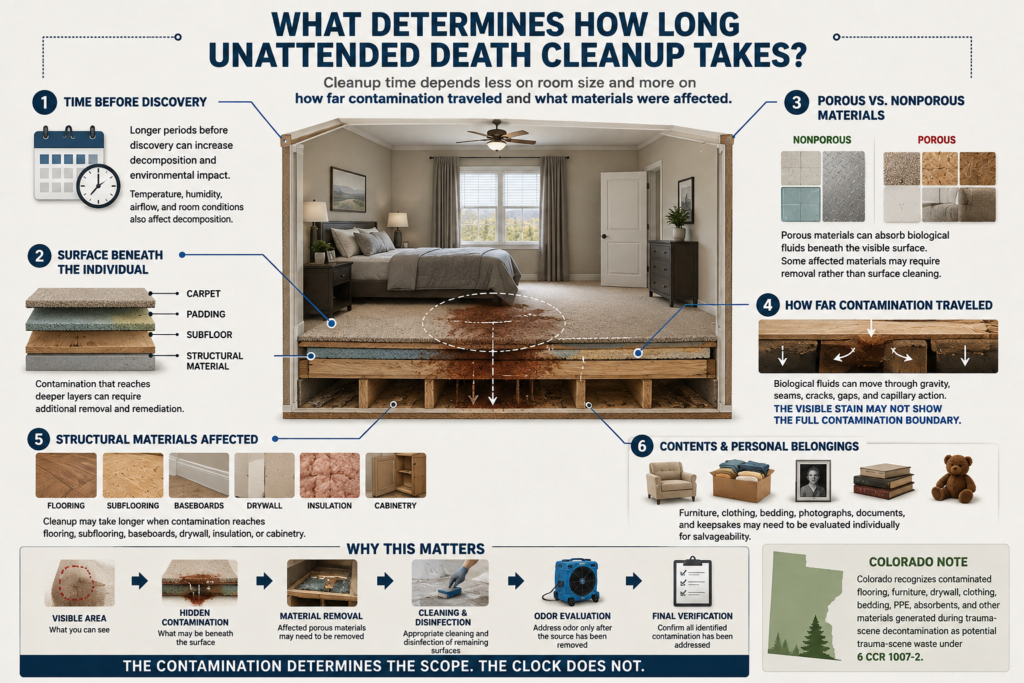
What Determines How Long an Unattended Death Cleanup Takes?
The timeline depends on what technicians find during assessment and remediation.
Several factors are especially important.
1. How Long the Person Was Undiscovered
The amount of time between death and discovery can influence the extent of decomposition and environmental contamination.
But time alone does not tell the whole story.
Decomposition can also be influenced by environmental conditions such as:
- Temperature
- Humidity
- Air movement
- Clothing and bedding
- Surface materials
- Location within the property
- Other conditions surrounding the body
That means two individuals undiscovered for the same number of days may leave behind very different remediation conditions.
2. What Material Was Beneath the Individual
Surface type can dramatically change the cleanup.
Consider two examples.
In the first situation, contamination is primarily confined to a removable piece of furniture.
In another, biological fluids have traveled through:
carpet → carpet backing → carpet padding → subfloor → flooring seams
The second situation can require substantially more investigation and material removal.
3. Whether the Material Is Porous
Porosity is one of the most important concepts in biohazard remediation.
Hard, nonporous surfaces may sometimes be capable of being cleaned and disinfected when their condition and the nature of the contamination permit.
Porous materials can present a different problem because liquids can penetrate beneath the visible surface.
Potentially affected porous materials include:
- Carpet padding
- Mattresses
- Upholstery
- Unfinished wood
- Particleboard
- Some subflooring
- Drywall
- Insulation
- Paper products
Spraying disinfectant onto the visible surface cannot be assumed to address contamination that has penetrated deeply into a porous material.
That can make removal necessary.
4. How Far Biological Fluids Traveled
Liquids do not respect the visible boundary of a stain.
They can move through:
- Gravity
- Capillary action
- Flooring seams
- Cracks
- Fastener penetrations
- Gaps between building materials
- Porous substrates
For example, what initially appears to be contamination limited to carpet may extend into the carpet pad and subfloor.
This produces one of the most important principles in unattended-death remediation:
The visible boundary of the scene is not necessarily the actual boundary of contamination.
5. Whether Building Materials Are Affected
The timeline can expand considerably when contamination reaches structural or finish materials.
Depending on actual conditions, remediation may require removal of affected:
- Carpet
- Padding
- Flooring
- Baseboards
- Subflooring
- Drywall
- Insulation
- Cabinet components
- Other porous building materials
Removing contaminated materials must also be performed without unnecessarily transferring contamination into unaffected portions of the property.
6. How Many Personal Belongings Are Present
An empty room can often be evaluated faster than a room containing decades of personal belongings.
Technicians may need to assess:
- Clothing
- Bedding
- Photographs
- Books
- Documents
- Furniture
- Electronics
- Boxes
- Collections
- Family keepsakes
Some items may be unaffected.
Some may potentially be cleaned.
Others may be too contaminated to reasonably salvage.
This part of the job deserves particular care because monetary value and emotional value are not the same thing.
A photograph or handwritten letter may have almost no resale value and still be irreplaceable to a family.
7. Whether Decomposition Odor Has Spread
Odor is another factor that can extend the remediation process.
Decomposition odors may migrate into surrounding areas through:
- Open doors
- Hallways
- Air movement
- Porous furnishings
- Building cavities
- Cracks and penetrations
But odor creates another important distinction.
Odor remediation is not a substitute for biohazard remediation.
Making a room smell better does not prove that the source of contamination has been removed.
Also Read ☣️How Meth Testing and Clearance Affect Real Estate Transactions in Colorado
What Does Colorado Require for Trauma-Scene Waste?
Colorado provides specific regulations governing medical waste, and those regulations are particularly relevant to professional unattended-death and trauma-scene cleanup.
Trauma-Scene Waste Is Specifically Recognized by Colorado
Colorado's solid-waste regulations define trauma-scene waste as a special category of medical waste.
The definition covers waste generated by decontamination of accident scenes, crime scenes, suicides, and other scenes involving serious human injury or death.
This can include:
- Blood and body fluids
- Potentially infectious waste
- Certain pathological waste
- Sharps
- Contaminated flooring
- Contaminated furniture
- Drywall
- Clothing
- Bedding
- Cleaning solutions
- Used PPE
- Wipes
- Absorbent materials
This is an important reason professional cleanup should not be treated as ordinary junk removal.
Colorado Requires Medical-Waste Management Procedures
Colorado's Section 13 medical-waste regulations require covered medical-waste generators to develop and implement an onsite medical-waste management plan.
Among other things, that plan must address how applicable medical waste will be identified, segregated, packaged, stored, treated, transported, and disposed of, and it must include contingency planning for spills or loss of containment.
Read Colorado's Section 13 Medical Waste Requirements
Household Disposal Guidance Is Not the Same as Commercial Biohazard Cleanup
This distinction is particularly important.
CDPHE publishes household guidance for disposing of small amounts of household medical waste. However, the department explicitly states that those household guidelines may not be used for waste generated, collected, or managed by businesses, schools, or government agencies.
Professional unattended-death cleanup therefore should not be confused with instructions for disposing of an ordinary household bandage or other small household medical waste.
CDPHE — Preparing Household Medical Waste for Disposal
What Federal OSHA Rules Apply to Professional Biohazard Cleanup?
Colorado does not operate an OSHA-approved state occupational-safety plan for private-sector workers. Most private-sector employers and workers in Colorado therefore fall under federal OSHA jurisdiction.
For employees whose duties create reasonably anticipated occupational exposure to blood or other potentially infectious materials, OSHA's Bloodborne Pathogens Standard, 29 CFR 1910.1030, establishes requirements involving exposure-control planning, engineering and work-practice controls, PPE, employee training, hepatitis B vaccination and post-exposure procedures, among other protections.
OSHA Bloodborne Pathogens Standard and Guidance
This is another reason professional death-scene remediation is fundamentally different from ordinary cleaning.
What Happens During Professional Unattended Death Cleanup?
The exact process depends on the scene, but professional remediation generally follows a logical progression.
Step 1: Assess the Affected Area
Before cleanup begins, technicians need to understand what happened to the property.
The assessment may consider:
- Where the individual was located
- Visible biological contamination
- Potential concealed contamination
- Affected building materials
- Personal belongings in the work area
- Potential sharps or other hazards
- Routes by which contamination may have traveled
- Appropriate PPE and work practices
- Waste-management requirements
The objective is to establish a defensible scope instead of guessing.
Step 2: Establish Controlled Work Practices
A poorly managed cleanup can spread contamination.
Technicians therefore need procedures designed to avoid carrying contaminants from the affected area into clean portions of the building.
Depending on the scene, this may involve controlled access, PPE procedures, designated waste handling, protective barriers, and clean/contaminated work practices.
The principle is straightforward:
Do not create a larger contaminated area while cleaning the original one.
Step 3: Remove Gross Biological Contamination
Visible biological material must be physically addressed.
Disinfectant should not be viewed as a magical substitute for removal and cleaning.
OSHA's Bloodborne Pathogens framework requires appropriate housekeeping and decontamination procedures for occupational blood exposure, while appropriate disinfectants must be used according to their labeled directions.
Step 4: Investigate Beneath the Visible Surface
This is often where the actual scope of an unattended-death cleanup becomes apparent.
Removing carpet, for example, may reveal contamination in the padding.
Removing the padding may reveal affected subflooring.
A technician should therefore follow the contamination pathway until the actual extent of affected material can be determined.
Step 5: Remove Materials That Cannot Be Adequately Remediated
Depending on the circumstances, contaminated porous materials may need to be removed.
These can include portions of:
- Carpet
- Padding
- Upholstery
- Mattresses
- Flooring
- Subfloor
- Drywall
- Insulation
Colorado specifically recognizes contaminated flooring, furniture, drywall, clothing, and bedding within its definition of trauma-scene waste.
Step 6: Clean and Disinfect Appropriate Remaining Surfaces
Once gross contamination and unsalvageable materials have been addressed, appropriate remaining surfaces can be cleaned and disinfected using products and procedures suitable for the conditions.
Product instructions matter.
Disinfectants have specific requirements concerning:
- Surface compatibility
- Concentration
- Application
- Contact time
- Required pre-cleaning
- Safety precautions
"Spray and immediately wipe" should not be assumed to constitute proper disinfection.
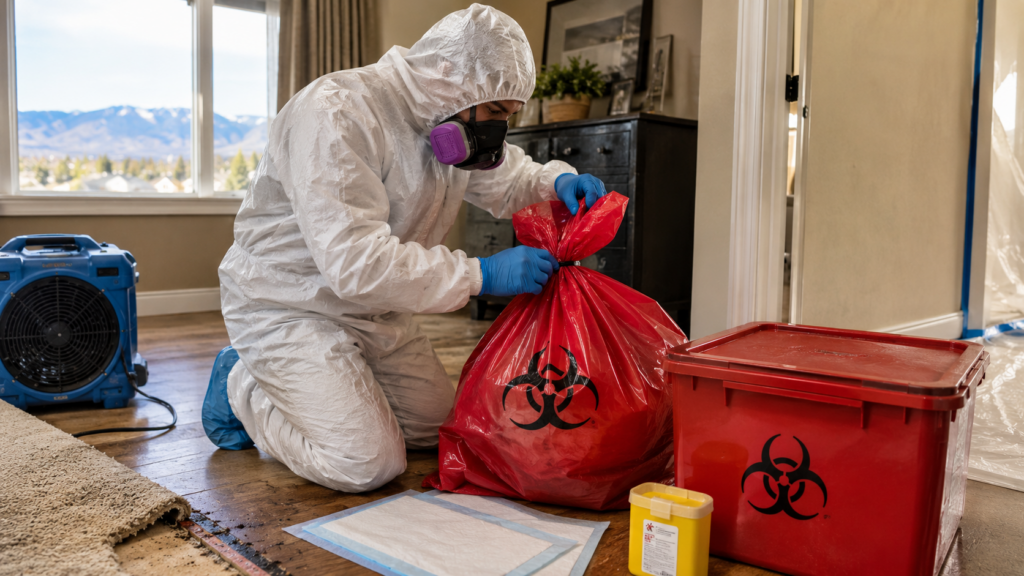
Step 7: Package and Manage Waste Correctly
Professional unattended-death remediation can generate regulated medical waste.
Colorado's medical-waste regulations address generator responsibilities, storage, treatment, disposal, and transportation. Untreated infectious waste from non-household sources cannot simply be assumed acceptable for ordinary solid-waste disposal.
Colorado's regulations also state that medical waste generally may only be transported to an approved commercial medical-waste storage, treatment, or disposal facility, subject to the provisions and exemptions contained in the regulation.
Step 8: Address Residual Odor
Odor treatment should follow source identification and removal.
That order matters.
Trying to deodorize a room while contaminated material remains beneath the flooring is similar to spraying fragrance near a leaking sewer line.
The odor may temporarily become less noticeable.
The source is still there.
Step 9: Perform a Final Evaluation
Before remediation is considered complete, the work area should be evaluated again.
Important questions include:
- Was identified contamination addressed?
- Were affected porous materials properly managed?
- Are additional contamination pathways suspected?
- Have appropriate remaining surfaces been cleaned and disinfected?
- Is residual odor indicating another source?
- Does the property now require reconstruction?
Completion should be based on the condition of the affected area—not merely on whether a stain disappeared or the room smells better.
Can an Unattended Death Be Cleaned Up in One Day?
Yes, sometimes.
A relatively contained scene with limited affected material may potentially be remediated within a working day.
But that should never become a universal promise.
Example: Limited Contamination
Suppose the primary affected material is a removable item and investigation shows that surrounding structural materials were not affected.
The remediation may be relatively short.
Example: Flooring and Subfloor Contamination
Now suppose fluids passed through carpet and padding and reached the subfloor.
Additional materials may have to be removed so technicians can determine where the contamination ends.
That can significantly increase the timeline.
Example: Advanced Decomposition
Consider a scene involving a longer period before discovery, multiple contaminated materials, numerous personal belongings, structural penetration, and decomposition odor that has migrated into adjacent areas.
That project may require several days or longer.
The room itself may not be any larger than the room in the first example.
The difference is the contamination pathway.
Why Exact Cleanup-Time Guarantees Can Be Misleading
Biohazard remediation is partly investigative.
A technician may remove one material and discover additional contamination beneath it.
For example:
Carpet is removed → contaminated padding is discovered → padding is removed → affected subfloor is discovered.
The scope changes because previously concealed conditions have become visible.
A responsible remediation plan should respond to what is actually found rather than stop because someone promised a predetermined number of hours.
The contamination should determine the scope. The clock should not.
Can Family Members Clean an Unattended Death Scene Themselves?
Significant biological contamination should not be approached as ordinary household cleaning.
Potential hazards can include:
- Blood and body fluids
- Potentially infectious material
- Sharps
- Contaminated porous materials
- Cross-contamination
- Improper waste handling
- Inadequate PPE
- Hidden contamination beneath flooring or other surfaces
For professional workers, OSHA's Bloodborne Pathogens Standard exists specifically because occupational contact with blood and other potentially infectious materials can create recognized workplace hazards.
Colorado's classification of trauma-scene material as medical waste adds another layer to professional cleanup and disposal.
What Should You Do After Discovering an Unattended Death?
If you discover someone who appears to have died, contact emergency authorities rather than attempting to investigate or clean the scene yourself.
After the appropriate authorities have completed their work and the property is available for cleanup, avoid unnecessarily disturbing the affected area.
Do not:
- Pull up contaminated carpet
- Move affected furniture unnecessarily
- Walk repeatedly through the affected area
- Vacuum suspected biological material
- Allow pets or children into the area
- Move contaminated belongings into clean rooms
- Attempt to cover decomposition odor with fragrance
Every unnecessary movement of contaminated material can create another opportunity for cross-contamination.
Can Personal Belongings Be Saved?
Sometimes.
Everything in the room does not automatically need to be discarded.
Items should be evaluated based on factors such as:
- Material
- Porosity
- Location
- Degree of contamination
- Ability to clean the item appropriately
- Sentimental or financial importance
A professional remediation company should be able to explain why an item can potentially be saved or why disposal is recommended.
This is especially important after an unattended death because the property contains more than "contents."
It contains someone's life.
Photographs, letters, family documents, jewelry, electronics, and keepsakes deserve thoughtful evaluation whenever conditions permit.
Does Homeowners Insurance Cover Unattended Death Cleanup?
Some homeowners, landlord, renters, or commercial property policies may provide coverage for certain biohazard-remediation or restoration costs, but coverage depends on the individual policy and circumstances.
Property owners should ask the insurance carrier specifically about:
- Biohazard remediation
- Unattended-death cleanup
- Removal of contaminated building materials
- Personal property
- Odor remediation
- Reconstruction
- Deductibles
- Documentation requirements
The insurance carrier ultimately determines what the policy covers.
Is Biohazard Cleanup the Same as Reconstruction?
No.
This distinction is important when discussing how long the entire process will take.
Suppose contaminated carpet, padding, baseboards, and part of the subfloor must be removed.
The biohazard-remediation phase may be finished before the room is fully restored.
Reconstruction might still require:
- Subfloor replacement
- New flooring
- Drywall repair
- Painting
- Baseboard replacement
- Cabinet repair
- Other finish work
So if someone says an unattended-death cleanup took two days, that does not necessarily mean the property was completely reconstructed within two days.
Ask whether a projected timeline refers to:
- Biohazard remediation
- Odor remediation
- Reconstruction
- The entire property-restoration process
They are not necessarily the same thing.
Does Waiting Make an Unattended Death Cleanup More Difficult?
It can.
As biological fluids remain in contact with porous materials, there is greater opportunity for absorption and migration into surrounding materials.
Environmental conditions may also influence decomposition and odor.
This does not mean families should panic.
It means that once the appropriate authorities have completed their work and cleanup can legally and practically proceed, arranging a professional assessment promptly can help establish what needs to happen next.
Why Can Decomposition Odor Return After Cleaning?
When decomposition odor disappears temporarily and later returns, one possibility is that the odor was treated without completely addressing its source.
Remaining source material may exist:
- Beneath flooring
- Within subfloor seams
- Behind baseboards
- Inside porous furniture
- Within another concealed material
Changing temperature and humidity can also alter how noticeable residual odors are.
That is why professional odor remediation should begin with source identification and removal, not perfume or masking agents.
Clean Is Not the Same as Remediated
This may be the most important distinction in the entire process.
A room can:
- Look clean
- Smell better
- Have no obvious staining
and still have unresolved affected material.
The opposite can also be true.
A properly remediated room may temporarily look worse because contaminated carpet, flooring, drywall, or other materials had to be removed.
Cosmetic cleaning asks whether the room looks clean.
Remediation asks whether the affected materials and contamination pathways have actually been addressed.
Those are very different standards.
What Should You Ask an Unattended Death Cleanup Company?
Before hiring a company, ask questions that reveal how it determines the actual scope of remediation.
Ask About the Contamination Boundary
- How will you determine what materials were affected?
- Will you investigate beneath visibly contaminated flooring when necessary?
- What happens if additional contamination is discovered?
Ask About Waste Management
- How will contaminated materials be packaged?
- How will the waste be transported?
- Where will applicable medical waste be taken?
- How does your process comply with Colorado medical-waste requirements?
Ask About Worker Safety
- How are technicians trained for bloodborne-pathogen exposure?
- What PPE and exposure-control procedures are used?
- How is cross-contamination prevented?
Ask About Your Belongings
- Which belongings may be salvageable?
- How are sentimental items handled?
- Will you explain why an item needs to be discarded before doing so when circumstances permit?
Ask What "Complete" Actually Means
- What determines when remediation is finished?
- How is remaining odor evaluated?
- Does your scope include reconstruction?
- What documentation will you receive?
Professional expertise should produce clarity, not confusion.
Colorado Resources for Unattended-Death and Biohazard Cleanup
Property owners who want to understand the rules governing professional trauma-scene waste in Colorado can review the regulations directly.
Colorado Department of Public Health and Environment
CDPHE's Hazardous Materials and Waste Management Division provides information concerning medical and solid-waste requirements in Colorado.
Colorado Department of Public Health and Environment — Medical Waste Regulations
Colorado Medical Waste Regulations
Colorado's medical-waste requirements are contained in 6 CCR 1007-2, Part 1, Section 13.
Colorado Secretary of State — Official 6 CCR 1007-2 Regulations
Colorado Solid Waste Guidance
CDPHE also maintains guidance and policy resources concerning solid waste and medical waste.
CDPHE Solid Waste Guidance and Policy
Federal OSHA Bloodborne Pathogens Requirements
Because Colorado does not have an OSHA-approved state plan covering private-sector workers, most private-sector employers in Colorado are under federal OSHA jurisdiction.
OSHA Bloodborne Pathogens Guidance
How Long Will Your Unattended Death Cleanup Take?
The answer cannot reliably be determined from the number of days someone was undiscovered alone.
A proper assessment asks:
Where did the contamination begin?
Where did it travel?
What materials absorbed it?
What can be cleaned?
What must be removed?
What must happen to the resulting waste?
A contained scene may be resolved relatively quickly.
A complicated scene involving structural materials, extensive contents, concealed contamination, or persistent decomposition odor may require considerably more time.
That is why a trustworthy remediation company should evaluate the actual conditions before making promises.
Frequently Asked Questions About Unattended Death Cleanup
How long does unattended death cleanup usually take?
A relatively limited scene may sometimes be completed within several hours or a day, while more complicated situations can require several days or longer. The timeline depends on the extent of contamination, affected materials, decomposition conditions, personal contents, structural involvement, and odor issues.
Can unattended death cleanup be completed in one day?
Sometimes. A contained scene with limited material involvement may potentially be remediated in a day. Structural contamination or extensive decomposition can substantially increase the time required.
What is trauma-scene waste in Colorado?
Colorado defines trauma-scene waste as waste generated through decontamination of accident scenes, crime scenes, suicides, and other scenes involving serious human injury or death. The definition can include contaminated flooring, furniture, drywall, clothing, bedding, PPE, cleaning materials, and sharps.
Does everything in the room have to be thrown away?
No. Items should be evaluated according to their material, location, exposure, and ability to be appropriately cleaned. Some belongings may be unaffected or salvageable, while certain heavily contaminated porous materials may require disposal.
Why would flooring or drywall need to be removed?
Porous building materials can absorb biological fluids beneath the visible surface. When contamination cannot be adequately addressed through surface cleaning, removal may be necessary to reach the actual extent of affected material.
Can decomposition odor be permanently removed?
Successful odor remediation depends heavily on identifying and addressing the source. Deodorizing the air without removing contaminated source material can allow odors to persist or return.
Is it safe to clean up an unattended death yourself?
Significant biological contamination can present exposure, sharps, cross-contamination, and waste-management concerns. Professional workers performing this work may be subject to OSHA bloodborne-pathogen requirements, while Colorado separately regulates applicable trauma-scene and medical waste.
Does homeowners insurance cover unattended death cleanup?
Some policies may cover certain remediation or restoration expenses, but coverage varies. The insurance carrier should be asked specifically about biohazard remediation, contaminated materials, personal property, odor remediation, and reconstruction.
When can cleanup begin after an unattended death?
Cleanup should not interfere with an active investigation or official scene processing. Once the appropriate authorities have completed their work and the property is available for remediation, a cleanup company can evaluate the affected area and establish the scope.
How do I know when the scene has been properly remediated?
Completion should be based on whether identified contamination and affected materials have been appropriately addressed—not simply whether stains have disappeared or the property smells better. The remediation company should be able to explain what was removed, what was cleaned, how waste was managed, and what work remains, if any.
When You Need Answers, You Should Not Have to Guess
An unattended death is not simply another property-cleaning project.
For the people involved, the affected space may have been someone's bedroom, apartment, favorite chair, or home.
The belongings inside may represent decades of memories.
And the people responsible for the property may already be trying to manage funeral arrangements, family notifications, insurance questions, legal responsibilities, and grief.
They should not also have to become experts in bloodborne-pathogen precautions, decomposition, medical-waste regulations, contaminated building materials, and odor remediation overnight.
Denver Decon provides professional biohazard cleanup and decontamination services throughout Denver and surrounding Colorado communities. Its service area includes Denver County as well as communities in Adams, Boulder, Jefferson, Larimer, and Weld counties.
The goal should never be to rush into the property, make the visible evidence disappear, and call the job finished.
The goal is to determine what was affected, address the actual contamination, protect unaffected areas and belongings whenever reasonably possible, manage applicable waste appropriately, and give the property owner a clear understanding of what happens next.
If you are dealing with an unattended death in the Denver area, Denver Decon can evaluate the property and explain the next steps based on the actual conditions found—not assumptions or unnecessary services.
Call or text Denver Decon at 720-825-2130 to discuss the situation and arrange professional assistance.