
Quick answer: If you find loose needles or sharps of unknown origin, stop cleaning, keep people and pets away, and arrange an assessment by a trained sharps-removal or biohazard-cleanup provider. Do not handle them with bare hands, recap them, vacuum them, or put them loose in the trash. Removal should include controlled collection, suitable sharps containers, an accepted disposal route, and a review of the affected area before regular cleaning continues.
Key Takeaways for Homeowners and Landlords
- Routine disposal of your own medical sharps differs from cleaning up abandoned needles.
- The location and concealment of sharps can matter more than the visible count.
- Gloves do not turn an uncontrolled cleanup into a safe task.
- Disinfecting a needle does not remove its ability to puncture skin.
- Confirm local disposal requirements and whether a program accepts waste from the particular cleanup.
- A needlestick injury needs immediate medical evaluation; do not wait for symptoms.
What Counts as a Sharp in a Residential Property?
Sharps are objects with points or edges capable of cutting or puncturing skin. In homes, medical sharps include hypodermic needles, syringes with attached needles, insulin pen needles, lancets used for blood testing, and certain injection devices. Veterinary care can generate sharps as well.
Broken glass, exposed razor blades, and other sharp debris can create additional injury hazards. When blood contamination is involved, collection and waste handling require particular care. Different items may need different packaging and disposal arrangements; a medical-sharps container is not a universal receptacle for every hazardous object.
The practical question is broader than “Is this a syringe?” Ask whether someone could be cut or punctured while touching, moving, bagging, or carrying the material. A sharp object hidden in an otherwise ordinary bag changes how that bag should be approached.
For context on waste categories, see Types of Biohazardous Waste and Disposal Procedures.
What Should You Do Immediately After Finding a Needle?
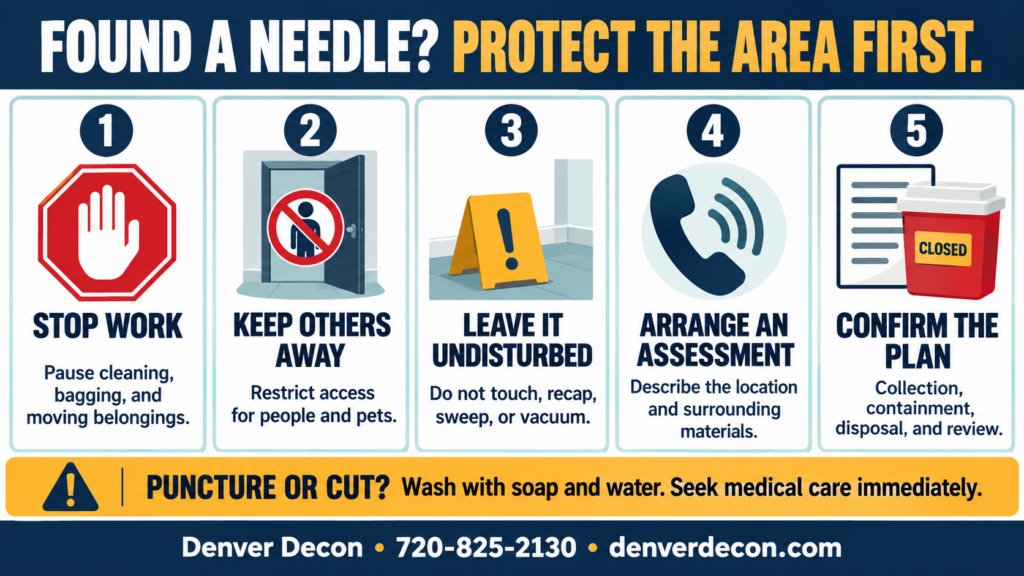
Stop The Work That Could Disturb It
Pause sweeping, vacuuming, bagging trash, moving furniture, or stripping bedding in the affected area. Tell anyone already working in the property what was found. A contractor arriving later should receive the same warning before beginning work.
Do not continue a cleanout while planning to “watch for needles.” That approach still requires people to handle items whose contents they cannot see. Stopping creates time to choose a method that accounts for hidden hazards.
Restrict Access Without Touching The Item
Keep children, pets, residents, cleaners, and maintenance workers away. Close the room if that can be done safely. If the item is in a shared space, notify property management promptly so access can be managed without obstructing emergency exits.
Do not carry the needle elsewhere to show someone. Avoid placing a towel over it, because concealing its location can create another encounter. Describe where it is and leave the area undisturbed for assessment.
Record What You Can Observe Safely
From a safe position, note the room, approximate location, and whether other items are visible. A photograph can help a cleanup provider understand the situation, but do not move belongings or approach the point to obtain a better image.
For rentals, record when the item was discovered and who was notified. Keep observations factual: “Syringe visible beside bathroom cabinet” is more useful than an unsupported conclusion about a tenant's behavior.
Arrange The Right Kind Of Help
Tell the provider whether the needle is loose, embedded in a material, mixed into clutter, or accompanied by blood or other contamination. Ask whether the company handles sharps assessment, collection, and disposal coordination, and what information it needs before attending.
A household member who already follows a medical sharps routine may need container-disposal guidance. An abandoned-property cleanout with unknown needles needs a broader assessment. The two situations should not be treated as interchangeable.
What If Someone Has Already Been Stuck or Cut?
Wash a needlestick puncture or cut with soap and water and seek medical care immediately. For a splash into the eyes, irrigate with clean water or saline. Report a work-related exposure to the appropriate supervisor promptly. These steps follow CDC/NIOSH exposure guidance.
Tell the clinician when the exposure occurred, what you were doing, and what you know about the object. A medical professional can assess the injury, vaccination history, bloodborne-infection concerns, testing, and follow-up needs. Do not delay care while attempting to locate the previous occupant or identify the source.
HIV post-exposure prophylaxis, when indicated, must begin within 72 hours, and sooner is better. That window is a reason to get care immediately, not a reason to wait. A discarded-needle injury does not automatically mean HIV medication is needed; the clinician determines the appropriate response.
Keep the cleanup provider informed that an injury occurred, but obtain medical care independently of the cleanup schedule. A property assessment cannot replace an exposure evaluation.
Why Shouldn't You Pick Up Abandoned Needles with Household Gloves?
Ordinary gloves are not a reliable barrier against a needle point. Even protective equipment selected for a particular job has limits. Safe work depends on controlling contact with the sharp, rather than relying on a glove to stop an unexpected puncture.
The FDA advises against bending, breaking, removing, or recapping needles used by another person. Those actions introduce extra handling at the sharp end. A needle does not need to look bloody for those precautions to matter.
Avoid these common shortcuts:
- Vacuuming: It moves the hazard into equipment someone must later handle.
- Ordinary sweeping: It can relocate or conceal a small sharp without controlling its final position.
- Squeezing bags: A hidden point can penetrate the bag toward the hand or leg.
- Feeling through upholstery: The hand reaches the concealed object before the worker can see it.
- Spraying and picking up: Surface treatment does not eliminate the physical point.
The same distinction applies to blood-contaminated surfaces: the work has to address the material and the exposure pathway. Read Why Blood Cleanup Requires More Than Household Disinfectant.
When Is Professional Sharps Removal the Appropriate Next Step?
Professional assessment is especially useful when the source is unknown, several items are present, or the setting makes additional sharps difficult to rule out. The issue is whether the affected materials can be approached safely and the scope can be defined.
| Situation | Appropriate Next Step |
|---|---|
| Your own used medical sharps are already properly contained. | Follow the container instructions and confirm an accepted local disposal option. |
| A loose needle of unknown origin is visible. | Restrict access and arrange trained assessment and removal. |
| Sharps are mixed with trash, bedding, furniture, or clutter. | Stop the cleanout and request a plan covering concealed sharps and affected materials. |
| There is associated blood or other biological contamination. | Request an assessment that covers both sharps and the separate contamination. |
| Someone has been punctured or cut. | Obtain immediate medical care while keeping others away from the area. |
Consider two examples. A single visible needle on an accessible hard floor may involve a limited work area. One needle found while emptying an upholstered chair may require a closer evaluation of the chair and nearby belongings. The visible count is the same, but the uncertainty is different.
Clutter can complicate access, visibility, and material handling. That does not mean every cluttered home contains sharps. It means a confirmed discovery should change the cleanout plan. Our guide to When Hoarding Becomes a Biohazard discusses related warning signs.
What Should a Professional Removal Plan Include?
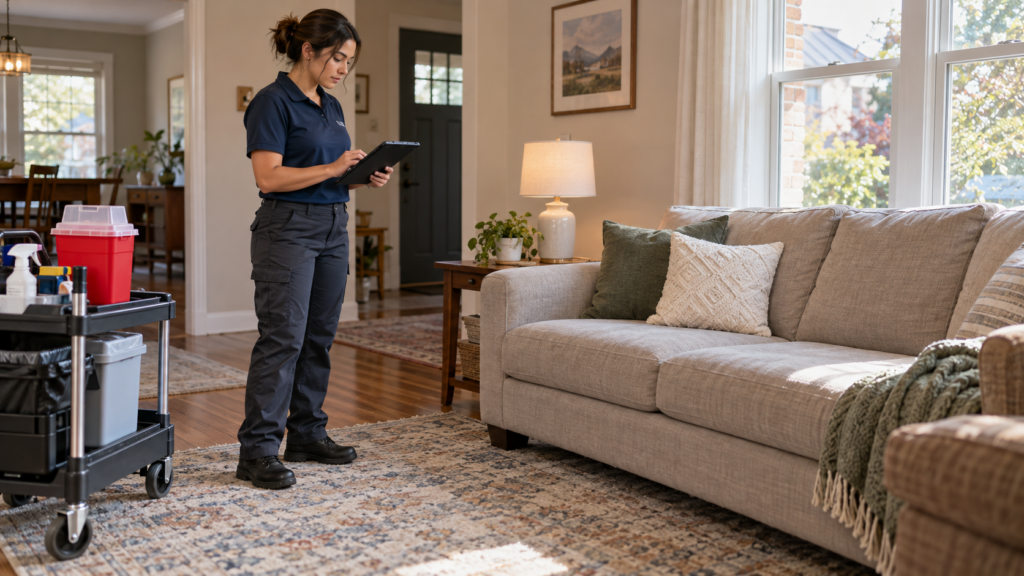
A useful plan explains how the provider will control the work area, collect sharps, assess affected belongings, manage other contamination, and arrange disposal. Ask for those elements in writing so the homeowner, property manager, and subsequent contractors understand the same scope.
1. An Assessment Of The Affected Area
The assessment should consider where the first item was found, what activities have already disturbed the area, and which materials could conceal additional items. Relevant information includes whether furniture was moved, bags were consolidated, or a vacuum was used before discovery.
That history helps the provider decide where to focus. It also prevents an overly narrow plan based only on the spot where the most recent needle was seen. Areas that cannot be accessed should be identified rather than silently excluded.
2. Controlled Access And A Deliberate Collection Method
The work should separate the affected zone from ordinary household traffic. Collection should use appropriate equipment and procedures that minimize contact with the sharp. Workers should have suitable containers available where collection occurs.
For employers whose employees have occupational exposure, OSHA's Bloodborne Pathogens Standard establishes requirements for exposure controls, training, protective measures, and post-exposure response. It also specifies closable, puncture-resistant, leakproof, labeled or color-coded containers for contaminated sharps. Applicability depends on the work and exposure, not simply the worker's job title.
Homeowners can ask how a provider addresses these subjects without trying to supervise the technical collection themselves. For a broader overview, see What Goes Into a Biohazard Cleanup?
3. A Plan For Furniture, Carpet, And Other Belongings
A needle beside a sofa does not automatically require disposal of the sofa. A needle embedded in an inaccessible upholstered cavity presents a different question. The provider should explain whether inspection is feasible, which components can be accessed, and whether material removal is warranted.
The same reasoning applies to carpet, mattresses, stored clothing, and bags. Ask why an item needs to be discarded, or why keeping it is reasonable within the inspection performed. Decisions should follow the condition and access limitations of the particular item.
4. Separate Treatment Of Related Contamination
Removing needles and cleaning blood are distinct parts of a job. If blood or other potentially infectious material is present, the scope should describe the affected surfaces and the cleaning, disinfection, or removal required for those materials.
Do not assume an entire room requires the same treatment because a syringe was found there. Conversely, collecting the syringe does not address blood that has soaked into a porous material. A sound estimate connects each task to an observed condition.
5. Appropriate Packaging And Disposal
The provider should identify the waste route before collection begins. Ask who will package and remove the material, what waste service will receive it, and what records will be available. A sealed container is an important control, but the plan still needs an accepted destination.
For more background, see How To Dispose Of Biohazard Waste Safely.
6. A Completion Review With Clear Limits
Ask which areas and belongings were assessed, what was removed, and whether any portions remained inaccessible. A statement that a room was “cleaned” is less useful than a description of the work completed.
No contractor should promise that a visual check proves the absence of every concealed sharp in every inaccessible cavity. When an unresolved area remains, the report should identify it and explain the next step. That information helps owners decide when other work can resume.
Which Containers Should Be Used for Medical Sharps?
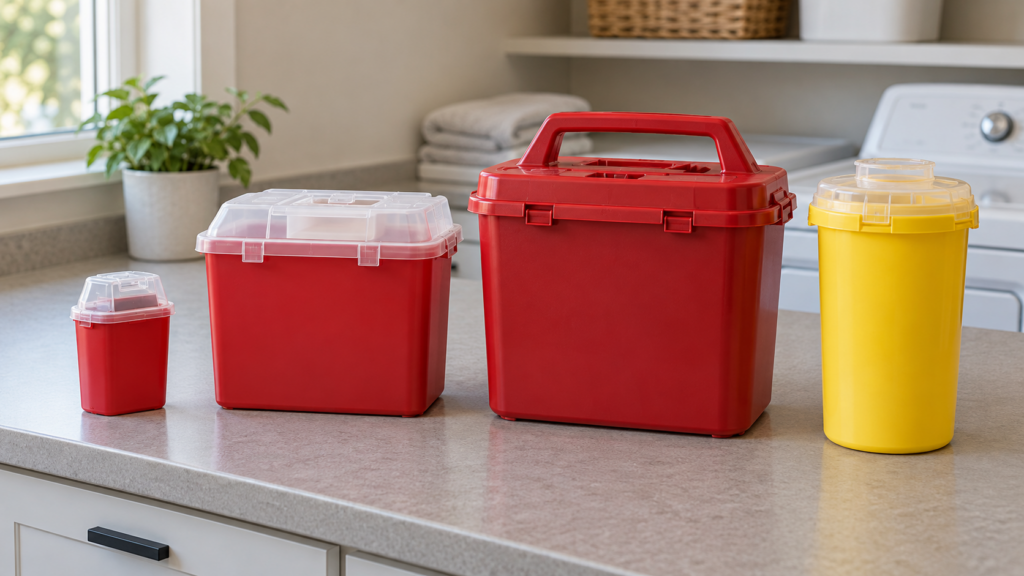
For routine home medical use, the FDA recommends FDA-cleared sharps containers. These are designed for the purpose and have a designated fill limit. Follow the manufacturer's instructions and do not overfill, reach inside, or reuse a disposable container.
Where community guidance permits an alternative household container, it should be heavy-duty plastic, stable, leak-resistant, properly labeled, and fitted with a tight, puncture-resistant lid. Thin drink bottles, ordinary bags, and cardboard boxes are unsuitable substitutes.
Check the receiving program's rules before selecting an alternative container. A container acceptable under one household guideline may not be accepted by a particular collection service. Commercial cleanup providers should use packaging appropriate to their waste arrangements and applicable requirements.
These container guidelines support prevention and disposal planning. They are not instructions to handle an abandoned needle before the situation has been assessed.
Where Can Needles and Sharps Be Disposed of in Denver?
Denver's public-health department operates a sharps-disposal kiosk program. Its official guidance explains container preparation, kiosk locations, and prohibited items. Colorado also maintains household sharps collection resources. Check current instructions before traveling, since acceptance conditions and availability can change.
For household sharps, possible routes include an authorized collection location or a dedicated mail-back service. Confirm participation first; a pharmacy, hospital, or fire station should not be assumed to accept sharps simply because of its role in the community.
Never place loose needles in ordinary trash or recycling, and do not flush them. Denver currently allows certain properly contained and labeled household sharps in trash under its published guidance. That is a local household provision, not a general authorization for every cleanup or every jurisdiction.
A landlord or cleanup company should confirm how the particular waste is classified and whether the chosen program accepts it. Do not assume a household kiosk accepts commercial cleanup loads. Ask about quantity limits, container requirements, and eligibility before making arrangements.
Start with Denver's Safe Sharps Disposal guidance and Colorado's local sharps collection information.
What Should Landlords and Property Managers Do Differently?
Pause The Turnover And Notify Everyone Who Needs To Know
Rental turnovers often involve several vendors: cleaners, painters, maintenance staff, flooring installers, and movers. A sharps discovery should reach each affected vendor before that person enters the work area. Make clear which tasks are paused and who will communicate when they can resume.
Routine turnover authorization should not be treated as proof that a worker is prepared for sharps removal. Ask the employer or provider how the particular hazard will be managed.
Keep Access And Disposal Decisions Separate From Blame
Document the condition and arrange an appropriate response without assuming that a syringe establishes illegal activity. Medical privacy, access rights, belongings, and financial responsibility can raise separate questions. If a dispute arises, obtain advice based on the lease, facts, and applicable Colorado law.
For broader property concerns where there is independent evidence of drug activity, see The Hidden Risks of Illegal Drug Use in Rental Properties. A needle alone does not establish those conditions.
Coordinate Work In The Right Order
A practical sequence is to control access, assess the sharps issue, complete the agreed removal and related cleanup, review the findings, and then authorize subsequent work in the areas addressed. If a previously inaccessible location becomes exposed during renovation, reassess it before workers proceed.
For example, a flooring contractor should know if carpet removal is expected to reveal an area that could not previously be inspected. The relevant handoff is specific: what has been checked, what has not, and who to contact if another sharp appears.
Request Useful Records
Keep the estimate, authorized scope, photographs taken safely, completion report, invoice, and available disposal records. Ask the provider to explain any difference between the initial estimate and the final work.
If you intend to submit a claim, request the insurer's documentation requirements early. Related guidance appears in What Insurance Companies Look for in Biohazard Remediation Documentation.
Do Needles Mean the Property Has Meth Contamination?
No. Finding a needle does not identify the substance associated with it, establish that a drug was used, or measure contamination on building surfaces. The collection of a physical sharp and the assessment of a chemical residue are separate questions.
Colorado has specific requirements for methamphetamine-affected properties. Where independent evidence supports a concern, consult an appropriately qualified professional about the applicable assessment process. Do not substitute a sharps-removal invoice for meth testing or required clearance.
If testing has already identified meth contamination, read What Happens When a Colorado Property Tests Positive for Meth? The next steps depend on those findings, rather than assumptions drawn from a syringe.
How Much Does Professional Sharps Removal Cost?
The cost should reflect the actual work: access, collection, inspection of affected materials, related contamination, waste handling, and documentation. A count of visible needles is only one part of the estimate.
One accessible item may involve a small scope. The same visible item inside a packed storage room may require staged access and more careful handling. Ask the provider to explain what it can estimate immediately and what may change after additional areas become accessible.
Request an itemized proposal covering:
- The rooms, belongings, and accessible areas included.
- Collection and container costs.
- Material removal or separate contamination cleanup, if needed.
- Waste transport and disposal arrangements.
- Completion documentation and any return visit.
- Conditions requiring further approval before added work proceeds.
Do not assume homeowners insurance, a rental policy, or a security deposit will cover the cost. Confirm coverage and responsibility for the particular situation. For general cost context, see How Much Does Biohazard Cleanup Cost in Denver?
How Can You Choose a Provider for Sharps Removal?
Ask about experience with residential sharps discoveries, the workers' exposure-control procedures, waste arrangements, and the scope of the final report. A useful explanation should connect the method to the setting you describe.
Specific questions include: How will concealed items be considered? What happens if a needle is found inside furniture? Who receives the waste? What remains outside the estimate? How are new findings communicated before the scope changes?
Avoid relying on a badge, a generic “certified” claim, or a promise that every property can be finished in the same number of hours. Ask what the qualification covers and how it relates to this job. Our article How Do You Know If a Cleanup Company Is Actually Qualified? provides more questions to bring to that conversation.
Common Myths That Can Lead to an Incomplete Response
“There Is No Blood, So It Is Just Trash.”
A visual inspection does not establish the history of a discarded sharp. More immediately, even an unused point can puncture someone during handling. The absence of a visible stain does not make ordinary bagging an appropriate response.
“One Needle Means The Whole Home Is Contaminated.”
A discovery calls for an assessment of the relevant area, not an automatic conclusion about every room. The provider should explain what observations justify expanding the scope. Ask how the discovery location, accessible materials, and known disturbance influenced the recommendation.
“If The Needle Is Gone, The Job Is Finished.”
Collection resolves the visible item. Completion also depends on what the agreed scope required: reviewing surrounding materials, addressing related contamination, arranging disposal, and identifying inaccessible areas. A narrow collection task and a broader property cleanout have different completion criteria.
“A Clean Smell Proves The Property Is Ready.”
Odor does not reveal whether a sharp remains inside a cushion, bag, or floor opening. Deodorizing a room cannot answer that question. Ask for findings tied to the physical inspection and work performed, rather than relying on how the room smells afterward.
“The Cheapest Quote Covers The Same Work.”
Two estimates can describe very different jobs. One may cover the visible floor item, while another includes furniture assessment, controlled material handling, disposal, and a report. Compare the written inclusions before deciding that one price represents better value. A clear scope also helps prevent surprise charges when another item is discovered.
How Can Future Sharps Discoveries Be Prevented?
For people using injectable medicines at home, prevention starts with having a suitable container available when the device is used and a disposal plan before that container fills. Ask the prescriber, pharmacist, or veterinarian about the appropriate routine for the specific device.
For rentals, a clear reporting process helps. Residents and workers should know whom to contact if they discover a sharp, and cleaners should know to stop rather than conceal the item in ordinary waste.
In shared spaces where discoveries recur, management can consider practical access, lighting, inspection, and reporting improvements. Keep the response focused on conditions and prevention. Respectful communication makes it easier for people to report hazards early.
After a cleanup, retain the report with property-maintenance records. If new work exposes an area outside the original scope, pass that information to the relevant contractor. Prevention includes managing what is still unknown. Make those limits part of the handoff, so each person understands the conditions before starting the next task.
10 Frequently Asked Questions About Needles and Sharps Removal
Can I Pick Up A Needle With Rubber Gloves?
Ordinary rubber or disposable gloves do not reliably prevent needle punctures. For a loose needle of unknown origin, keep people away and arrange trained assessment and removal rather than relying on gloves.
Should I Put The Cap Back On A Used Needle?
Do not recap a discarded needle used by someone else. The extra handling can cause a puncture. Leave the item undisturbed and keep others away while arranging removal.
Can Needles Go In Household Trash?
Never put loose needles in household trash or recycling. Some local rules allow properly contained and labeled household sharps in trash, but requirements vary. Confirm the rules for your location and the source of the waste.
What Should I Do If A Needle Punctures My Skin?
Wash the puncture with soap and water and seek medical care immediately. Report work-related exposures promptly. A clinician will assess the injury and determine testing, treatment, and follow-up needs.
Does Finding One Needle Mean There Are More?
Not necessarily. However, the location and surrounding materials should inform the assessment. A discovery in upholstery, clutter, or bagged debris may justify evaluating additional accessible areas before cleaning continues.
Does The Whole Carpet Or Sofa Have To Be Thrown Away?
Not automatically. Decisions depend on the item, the location of the sharp, access for inspection, and associated contamination. Ask the provider to explain what can be assessed and why any removal is recommended.
Can A Regular Cleaner Remove Needles From A Rental?
Do not assume a routine cleaning service is prepared for sharps removal. Confirm relevant training, exposure controls, equipment, containers, and waste arrangements before authorizing the work.
Does A Syringe Prove There Was Illegal Drug Use?
No. Syringes and other sharps have many medical uses, including diabetes care and veterinary treatment. A syringe alone does not establish illegal activity or methamphetamine contamination.
Can I Take Sharps To Any Pharmacy Or Fire Station?
No. Participation and acceptance rules vary. Confirm that a specific location accepts your sharps, container type, quantity, and waste source before transporting them.
What Should I Ask For After A Sharps Cleanup?
Request a written description of the areas assessed, work performed, materials removed, waste arrangements, and any inaccessible areas or remaining recommendations. Retain available disposal records and the invoice.

Take the Next Step Toward a Safer Property
Finding needles in a home or rental can make an ordinary task feel uncertain. You do not have to resolve that uncertainty by moving more belongings or asking a regular cleaner to keep going. Start by protecting access and getting a clear assessment of what was found.
A useful cleanup plan should explain the affected area, how sharps will be collected and contained, how related contamination will be addressed, and where the waste will go. It should also identify any areas that could not be inspected. Those answers give you a practical basis for deciding what happens next.
Whether you are caring for a family home or preparing a rental for its next occupant, the objective is the same: reduce exposure, complete the necessary work, and make the handoff clear for everyone who follows.
Contact Denver Decon to discuss needles, sharps, or related biohazard concerns and request an assessment of your property. Describe the location and condition from a safe distance so the appropriate scope can be discussed.
Call or text 720-825-2130 or visit denverdecon.com.