
Biohazard cleanup in Denver typically costs between $1,500 and $5,000, based on published national pricing benchmarks. A small, contained incident may cost approximately $500 to $1,500, while an unattended death, extensive blood contamination, sewage exposure, or multi-room cleanup can cost $5,000 to $10,000 or more.
Severe cases involving prolonged decomposition, structural material removal, hazardous-waste transportation, extensive odor remediation, or widespread contamination may exceed $15,000 to $25,000.
These figures are planning ranges—not guaranteed quotes. A qualified biohazard remediation company must evaluate the affected materials, contamination boundaries, safety requirements, labor, and disposal needs before determining an accurate price.
The most important point is that professional biohazard cleanup is not priced like ordinary house cleaning. The cost reflects exposure control, specialized equipment, regulated waste handling, disinfection, documentation, and the removal of contaminated materials that cannot be safely restored.
Average Biohazard Cleanup Costs in Denver
The following ranges can help Denver property owners understand the possible financial scope of a cleanup:
| Type of biohazard cleanup | Typical planning range |
|---|---|
| Small, contained blood cleanup | $500–$1,500 |
| Moderate blood or bodily-fluid cleanup | $1,500–$4,000 |
| Crime or trauma scene cleanup | $2,000–$7,500 |
| Unattended death cleanup | $3,000–$10,000+ |
| Sewage or fecal contamination cleanup | $1,500–$6,000+ |
| Biohazardous hoarding cleanup | $3,000–$15,000+ |
| Vehicle biohazard cleanup | $500–$3,000+ |
| Extensive structural contamination | $10,000–$25,000+ |
A published consumer cost guide places the national average at approximately $1,500 to $5,000, with unusually complex or dangerous projects potentially reaching $25,000. Denver pricing may fall above or below these benchmarks depending on the specific property, response time, contamination, and disposal requirements.
An honest estimate should explain what is included, identify foreseeable additional costs, and distinguish between cleaning, demolition, waste disposal, odor remediation, and reconstruction.
Also Read 📖What Are the Health Risks of Living in a Meth-Contaminated Home?
What Determines the Cost of Biohazard Cleanup?
No two biohazard scenes are identical. A visible stain may represent only a small portion of the actual contamination, particularly when blood or bodily fluids have migrated beneath flooring, behind baseboards, inside wall cavities, or into porous building materials.
The following factors usually have the greatest effect on price.
Size of the Contaminated Area
A contained incident on a sealed, nonporous surface may require relatively limited remediation. Contamination affecting carpet, padding, subflooring, furniture, drywall, or multiple rooms requires more labor, materials, containment, and waste capacity.
Contractors should evaluate the affected area, not merely the overall room size.
Type of Biohazard
Blood, bodily fluids, human waste, animal waste, sewage, drug residue, and decomposition each present different remediation challenges.
Blood and certain bodily fluids must be treated as potentially infectious. OSHA’s Bloodborne Pathogens Standard establishes workplace safeguards for occupational exposure to blood and other potentially infectious materials. These safeguards can include exposure-control procedures, personal protective equipment, training, decontamination practices, and appropriate handling of contaminated materials.
Porous Versus Nonporous Materials
Sealed metal, glass, and certain hard surfaces may be cleanable when appropriate products and procedures are used. Porous materials can absorb contamination beyond the visible surface.
Depending on the circumstances, technicians may need to remove:
- Carpet and padding
- Upholstered furniture
- Mattresses and bedding
- Unfinished wood
- Drywall
- Insulation
- Subflooring
- Baseboards and trim
- Personal belongings that cannot be decontaminated
Material removal increases labor, disposal volume, and eventual reconstruction costs.
Time Before Cleanup Begins
Time can significantly affect the scope of an unattended death or bodily-fluid cleanup. Liquids can penetrate deeper into structural materials, while decomposition can produce persistent odors and additional contamination.
Warm indoor conditions may accelerate decomposition. Denver’s seasonal temperature swings also matter: a closed building can become surprisingly warm even when outdoor temperatures are moderate.
Prompt action cannot reverse existing damage, but it may help prevent contamination and odor from spreading farther.
Required Containment and PPE
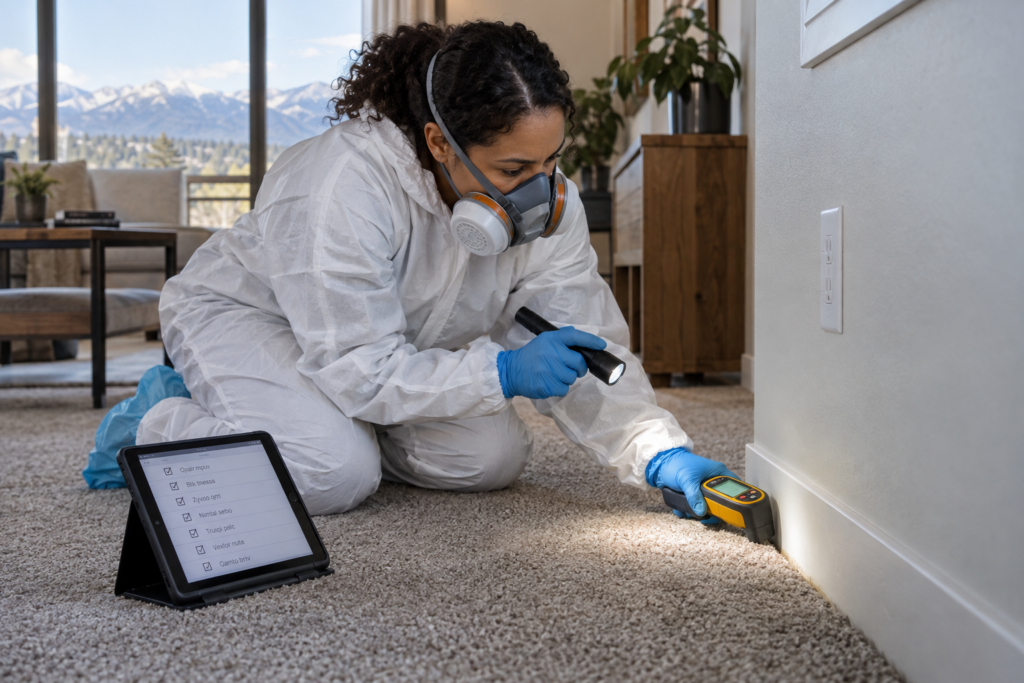
Technicians may need disposable suits, gloves, protective footwear, eye protection, respiratory protection, and controlled work zones. More complex scenes can require containment barriers, negative-air equipment, decontamination areas, and careful movement of personnel and waste.
These safeguards protect workers, occupants, neighboring areas, and the property itself from cross-contamination.
Biohazard Waste Packaging and Disposal
Contaminated absorbent materials cannot necessarily be placed in ordinary household trash. Waste may need to be segregated, packaged, labeled, transported, and delivered to an appropriate facility.
The Colorado Department of Public Health and Environment provides guidance covering medical and pharmaceutical waste management. Disposal requirements and facility charges can add substantially to a project, especially when carpet, furniture, drywall, or other bulky materials must be discarded.
Odor Remediation
Persistent odor is common after decomposition, sewage exposure, and some hoarding situations. Effective odor remediation begins with removing the contaminated source.
Fragrance, household deodorizer, ozone, or surface spraying cannot compensate for biological material left underneath flooring or inside a wall. Additional deodorization may be appropriate only after contaminated materials have been removed and affected surfaces have been cleaned and disinfected.
Accessibility and Working Conditions
Cleanup may cost more when technicians must work in a confined crawlspace, congested apartment, stair-only building, remote part of a property, or room with limited ventilation.
Restricted parking, elevator coordination, building management requirements, and discreet access can also affect labor and logistics at Denver apartments and commercial properties.
Emergency and After-Hours Response
Biohazard incidents rarely occur on a convenient schedule. Nights, weekends, holidays, or requests for an immediate response may involve emergency mobilization charges.
Ask whether after-hours fees are included before authorizing service.
Also Read ☣️How Meth Testing and Clearance Affect Real Estate Transactions in Colorado
What Is Included in Professional Biohazard Cleanup?
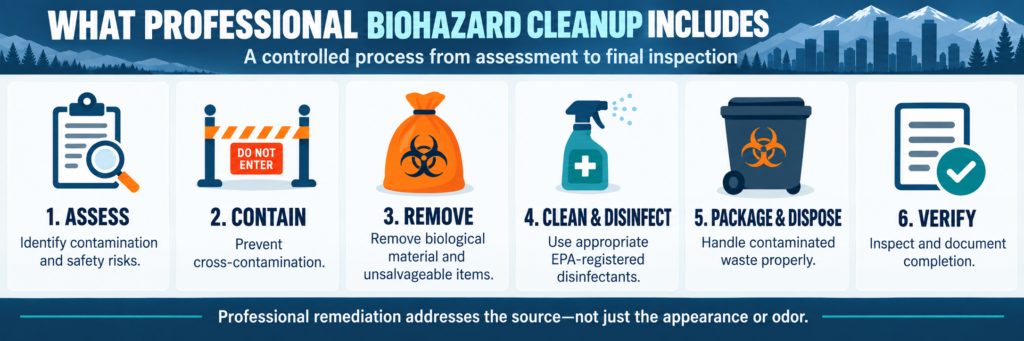
Professional remediation should address the full contamination problem—not simply improve the way the area looks or smells.
A properly scoped cleanup may include:
- Initial assessment: Identifying affected surfaces, materials, safety concerns, and possible migration paths.
- Work-zone control: Restricting access and establishing containment when needed.
- Personal protection: Using task-appropriate PPE and exposure-control procedures.
- Gross contamination removal: Removing visible biological material with controlled methods.
- Selective demolition: Removing porous structural materials that cannot be safely restored.
- Cleaning: Removing soils that could interfere with the disinfectant.
- Disinfection: Applying an appropriate EPA-registered product according to its label, including the required contact time.
- Waste handling: Packaging and arranging the lawful disposal of contaminated materials.
- Odor-source removal: Locating and removing residual contamination responsible for persistent odor.
- Final inspection: Confirming that the documented remediation scope has been completed.
The EPA maintains List S, which identifies registered antimicrobial products effective against specified bloodborne pathogens, including HIV and hepatitis B and C. Product selection alone, however, does not guarantee successful remediation. The surface must be properly cleaned, the label must be followed, and the disinfectant must remain wet for its required contact time.
Why Biohazard Cleanup Costs More Than Standard Cleaning
Hiring an ordinary cleaner may appear less expensive, but routine cleaning services generally are not equipped for bloodborne-pathogen exposure, contaminated-material removal, regulated waste, or structural remediation.
Professional biohazard pricing can account for:
- Specialized technician training
- Exposure-control procedures
- Commercial-grade PPE
- Containment equipment
- HEPA-filtered air control
- Professional cleaning and disinfection products
- Single-use remediation supplies
- Contaminated-material packaging
- Waste transportation and disposal
- Detailed documentation
- Commercial liability and pollution-related insurance
- After-hours availability
- Emotional sensitivity and discreet service
The difference is not merely how thoroughly a room is cleaned. It is whether the contamination is identified, controlled, removed, treated, and documented using an appropriate process.
Also Read 👉🏻How Do Buyers Discover Meth Contamination During Home Inspections?
Cost by Type of Biohazard Incident
Blood and Bodily-Fluid Cleanup
A small, contained blood spill may cost approximately $500 to $1,500. The price can increase rapidly when blood has soaked through carpet, entered floor seams, reached the subfloor, contaminated furniture, or spread across multiple areas.
The amount of visible blood does not always reveal the full extent of the contamination.
Crime and Trauma Scene Cleanup
Crime or trauma scene cleanup may cost approximately $2,000 to $7,500 or more. The final amount depends on the location, affected materials, law-enforcement release, number of rooms, waste volume, and restoration needs.
Cleanup should not begin until law enforcement or the appropriate authority has released the property.
Unattended Death Cleanup
Unattended death remediation is often one of the more expensive biohazard services, commonly ranging from $3,000 to $10,000 or more.
Cost increases may result from:
- The length of time before discovery
- Temperature and indoor conditions
- Fluid migration into flooring or structural cavities
- Insect activity
- Contaminated furnishings
- Multi-level penetration
- Extensive odor-source removal
- Required demolition
- Large volumes of regulated waste
A surface-only treatment is unlikely to resolve an unattended death when decomposition fluids have entered porous materials.
Suicide Cleanup
Suicide cleanup can range from approximately $2,000 to more than $10,000, depending on the affected area and level of structural damage.
Families should not be expected to manage these conditions themselves. A professional team can handle the physical cleanup while communicating with discretion and respect.
Hoarding With Biohazard Contamination
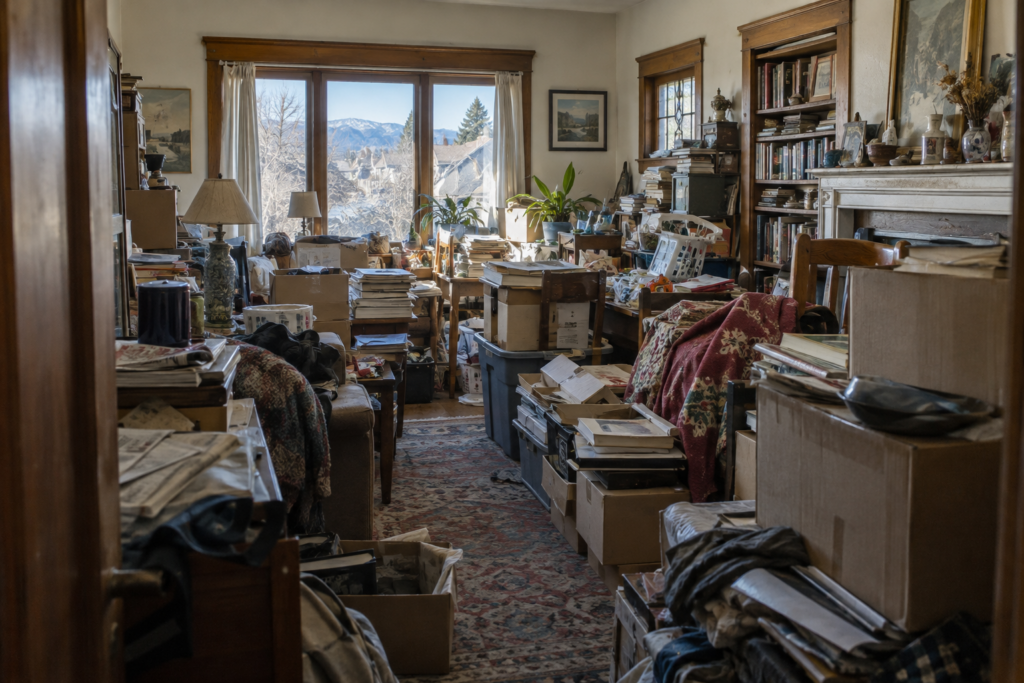
Hoarding cleanup involving ordinary belongings and clutter is different from hoarding that includes feces, urine, decomposed animals, sharps, spoiled food, sewage, or other biological contamination.
Biohazardous hoarding projects may cost $3,000 to $15,000 or more, particularly when the property requires extensive sorting, contents removal, structural remediation, pest coordination, or multiple waste loads.
Sewage Contamination
Sewage can contain bacteria, viruses, parasites, and other contaminants. Cleanup may range from $1,500 to $6,000 or more, depending on the water volume, affected materials, and how long the sewage remained in place.
Carpet, padding, drywall, insulation, and other porous materials may require removal rather than surface treatment.
Vehicle Biohazard Cleanup
Vehicle remediation frequently costs between $500 and $3,000, although severe contamination can make replacement more economical than restoration.
Seats, carpeting, headliners, ventilation components, and concealed cavities can complicate the work.
Does Homeowners Insurance Cover Biohazard Cleanup?
Homeowners, renters, commercial-property, or automobile insurance may cover some biohazard cleanup expenses when the incident results from a covered event.
Coverage depends on:
- The cause of the contamination
- The specific policy language
- Applicable exclusions
- Whether the event occurred suddenly or developed over time
- Structural damage
- Contents coverage
- Vehicle coverage
- Deductible amounts
- Policy limits
Insurance may cover cleanup and removal without covering every reconstruction or contents expense. Damage associated with neglect, long-term conditions, certain criminal activity, or excluded causes may receive limited or no coverage.
Before discarding property or authorizing nonemergency demolition, consider taking photographs and contacting the insurer. A reputable cleanup company may help document the affected area and communicate the remediation scope, but only the insurer can determine coverage.
Also Read 👉🏻How Do You Know If a Cleanup Company Is Actually Qualified?
Can Denver Crime Victim Compensation Help?
Qualifying victims and families may be eligible for financial assistance through Denver’s Crime Victim Compensation program. Depending on eligibility and program rules, assistance may be available for certain crime-related losses, potentially including crime-scene cleanup.
The program is administered through the Denver District Attorney’s Office. Applicants should contact the program directly for current eligibility rules, deadlines, documentation requirements, and benefit limits.
Victim compensation is separate from homeowners or renters insurance. In some cases, both resources may need to be coordinated.
How to Read a Biohazard Cleanup Estimate
A low initial number is not necessarily a low final price. Before selecting a Denver biohazard cleanup company, request a written estimate that identifies:
- Labor and technician rates
- Emergency-response charges
- PPE and disposable supplies
- Containment equipment
- Cleaning and disinfection
- Material removal
- Waste packaging
- Transportation and disposal fees
- Odor remediation
- Contents handling
- Post-remediation documentation
- Reconstruction exclusions
- Conditions that could change the estimate
Be cautious when a company offers a firm price without understanding the incident, affected materials, room configuration, or contamination spread.
The best estimate is not automatically the cheapest. It is the estimate that clearly connects the proposed work to the actual conditions.
Also Read 👉🏻What Role Do Air Scrubbing, VOC Control, and CLO₂ Play in Meth Remediation?
Questions to Ask a Denver Biohazard Cleanup Company
Before hiring a contractor, ask:
- Do you have experience with this specific type of biohazard?
- Are your technicians trained in bloodborne-pathogen and exposure-control procedures?
- What insurance coverage does your company carry?
- How will you determine the boundaries of the affected area?
- Which materials can be restored, and which must be removed?
- Are waste transportation and disposal included?
- What circumstances could increase the final price?
- Do you use EPA-registered disinfectants appropriate for the target organisms?
- How do you prevent cross-contamination?
- Will you provide a written scope and completion documentation?
- Can you communicate with my insurance adjuster?
- Is reconstruction included or billed separately?
- Can the work be performed discreetly?
Clear answers are a strong indicator that the company understands both the technical and human sides of biohazard remediation.
Can You Clean Up a Biohazard Yourself?
A minor incident involving a small amount of blood from a healthy household member on a nonporous surface may be manageable with appropriate precautions. Larger, unknown, traumatic, decompositional, sewage-related, or sharps-related contamination should be treated differently.
Do not attempt cleanup when:
- The source is unknown
- A substantial amount of blood or bodily fluid is present
- Fluids have entered porous building materials
- Needles or other sharps are present
- Decomposition has occurred
- Sewage has affected indoor materials
- Contamination has reached multiple rooms
- Strong odor remains after visible material is removed
- You do not have suitable PPE, products, training, or disposal options
Never mix cleaning chemicals. In particular, mixing bleach with ammonia or acidic products can create dangerous gases.
Professional help is not simply about avoiding an unpleasant task. It reduces the risk of direct exposure, accidental sharps injuries, chemical misuse, improper disposal, and contamination being spread to clean areas.
Also Read 👉🏻How Can Hidden Odors Destroy Property Value and Tenant Retention?
How Long Does Biohazard Cleanup Take?
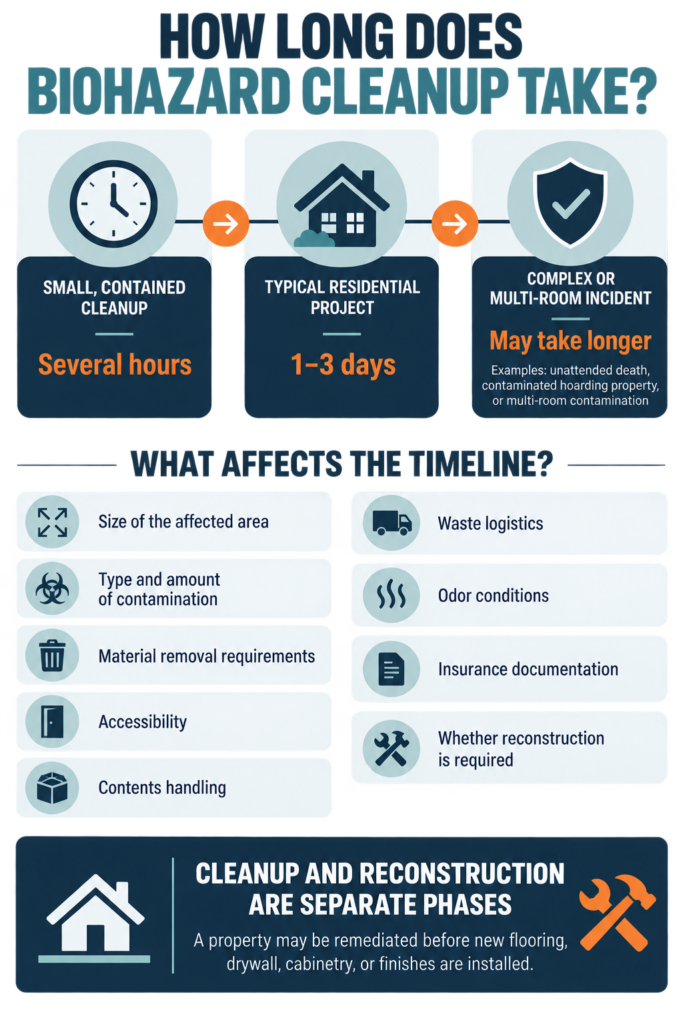
A small, contained cleanup may take several hours. A typical residential project may require one to three days, while an unattended death, contaminated hoarding property, or multi-room incident may take longer.
The timeline depends on:
- Size of the affected area
- Type and amount of contamination
- Material removal requirements
- Accessibility
- Contents handling
- Waste logistics
- Odor conditions
- Insurance documentation
- Whether reconstruction is required
Cleanup and reconstruction are separate phases. A property may be remediated before new flooring, drywall, cabinetry, or finishes are installed.
How to Reduce the Risk of Additional Damage
After discovering a suspected biohazard:
- Keep people and pets away from the area.
- Do not touch or walk through contaminated material.
- Do not run fans or HVAC equipment that may spread contaminants or odor.
- Do not use a household vacuum, mop, or carpet-cleaning machine.
- Do not spray fragrance or chemicals over the affected area.
- Wait for law-enforcement release when the incident involves a crime or death investigation.
- Contact a qualified biohazard cleanup provider.
- Notify the appropriate insurer when coverage may apply.
Avoiding traffic through the area is particularly important. Shoes, wheels, cleaning tools, and personal belongings can transfer biological material into previously unaffected spaces.
Also Read 👉🏻What Goes Into a Biohazard Cleanup? Colorado Safety Protocols & Certification Requirements
Frequently Asked Questions About Denver Biohazard Cleanup Costs
How much is a small blood cleanup in Denver?
A small, contained incident may cost approximately $500 to $1,500. Penetration into carpet, padding, wood, furniture, or subflooring can increase the cost.
How much does unattended death cleanup cost?
Unattended death cleanup often ranges from $3,000 to $10,000 or more. The length of time before discovery, structural penetration, temperature, odor, waste volume, and affected contents all influence pricing.
Do biohazard companies provide free estimates?
Policies vary. Some companies provide telephone guidance or an onsite assessment without charge, while others charge an inspection or emergency-response fee. Ask before scheduling.
Is odor removal included?
Not always. Basic odor treatment may be included, but extensive deodorization, structural removal, or treatment of additional affected areas may be billed separately. The source of the odor must be removed before deodorization can provide a dependable result.
Does a landlord pay for biohazard cleanup?
Responsibility depends on the cause, lease terms, insurance policies, and applicable law. Property owners, tenants, insurers, estates, or responsible third parties may become involved. A cleanup contractor should not offer legal conclusions about liability.
Will insurance pay the cleanup company directly?
Some contractors can work with an insurance carrier, but payment arrangements differ. The property owner may remain responsible for the deductible, exclusions, noncovered work, or any difference between the invoice and insurance payment.
Is reconstruction included in the cleanup price?
Usually not unless the proposal specifically says so. Biohazard remediation may leave areas ready for reconstruction, but replacement flooring, drywall, paint, cabinetry, or personal property can be separate expenses.
What You Should Do Next. . . Get a Clear Biohazard Cleanup Estimate in Denver
Discovering blood, bodily fluids, decomposition, sewage, or other biological contamination inside a property can leave you facing questions you never expected to answer. You may be worried about exposure, odor, permanent damage, insurance, cost, and whether the property can ever feel safe again.
Those concerns deserve more than a rushed price or a surface-level cleaning.
A professional assessment can determine where the contamination traveled, which materials can be restored, what must be removed, and what the work is likely to cost. That replaces guesswork with a documented plan—and helps prevent you from paying for unnecessary services or discovering major omissions after work begins.
Contact our Denver biohazard cleanup team for a confidential assessment and a clear explanation of your options. We will help you understand the scope, expected cost, insurance documentation, and next steps so you can move toward a clean, safe, and usable property with confidence.