
For Denver homeowners, landlords, and property managers, the most useful starting point is understanding what “Category 3 water” means—and how that classification changes the cleanup plan. You do not need to identify every contaminant yourself. You need a clear process for protecting people, assessing the damage, and deciding what happens next.
What Is the Difference Between Sewage Cleanup and Water-Damage Cleanup?
Water-damage cleanup is the broader service. It can involve water from a plumbing leak, appliance failure, roof opening, sewer backup, or outdoor flooding. The source and conditions determine the response. Sewage cleanup adds a contamination problem that cannot be solved simply by extracting water and drying the room.
Consider two otherwise similar basement rooms. In one, a newly broken drinking-water supply line wets the floor. In the other, wastewater backs up through a floor drain. Both rooms may need moisture assessment. However, the second requires a plan for contaminated materials and controlled work before ordinary restorative drying proceeds.
| Decision | Relatively Clean Supply-Water Loss | Sewage-Contaminated Loss |
|---|---|---|
| First assessment | Confirm source, safety, and moisture spread | Confirm those issues and contamination pathways |
| Material decisions | Some wet materials may be candidates for drying | Directly contaminated absorbent materials often need removal |
| Work area | Controls depend on actual conditions | Contamination controls and worker protection are central |
| Cleaning | Based on the source and affected surfaces | Physical soil removal followed by suitable disinfection where applicable |
| Completion | Address moisture and resulting damage | Address contamination, moisture, and resulting damage |
These are planning differences, not a diagnosis from a photograph. A supply-water loss can become more complicated after contact with existing contamination. A sewage backup can extend beyond the area where water is still visible. The assessment should explain what was found and how it affects the proposed work.
What Does Category 3 Water Mean?
Restoration terminology commonly groups water into three categories. Category 1 begins with a sanitary source. Category 2 has meaningful contamination. Category 3 is grossly contaminated water that may contain harmful microorganisms or other agents. “Black water” is a common informal name for Category 3; it does not mean the water must look black.
The IICRC’s published S500 position statement identifies sewage and certain waste-line backflows as Category 3 examples, regardless of visible color. It also clarifies that rain entering a building is not automatically Category 3. Inspection and the actual contamination conditions matter. [1]
Another distinction: category concerns contamination, while the drying class concerns the water load and drying challenge. “Class 3” and “Category 3” are not interchangeable.
When reviewing an estimate, ask what evidence supports the classification. A useful explanation connects the source and affected materials to the cleanup scope rather than treating a category number as a complete explanation.
What Should You Do Immediately After a Sewage Backup?
Your first job is to prevent additional exposure and get the right help involved. Trying to rescue every item immediately can create more work and bring contaminated material into unaffected rooms.
- Keep people and pets out. Restrict access, including the route through the affected room. Keep children away from wet belongings and cleanup equipment.
- Avoid standing water and electrical hazards. Do not enter water to reach a breaker, unplug an appliance, or inspect equipment. Have the utility, emergency responders, or a qualified electrician address an unsafe electrical situation.
- Stop using affected plumbing. Do not keep flushing or running appliances to see whether the backup has cleared. A plumber or sewer utility should determine the source.
- Document from a clean, safe location. Record when you noticed the problem, where water appeared, and which rooms or belongings seem affected. Photographs are useful when they do not require unsafe entry.
- Arrange professional assessment. Explain that sewage or a drain backup is involved so the responding team can plan appropriately.
- Notify the owner, manager, and insurer as applicable. Ask what documentation they need while necessary safety and mitigation work is arranged.
CDC advises avoiding floodwater because it may contain sewage, chemicals, debris, and other hazards. If contact occurs, wash exposed skin with soap and clean water. Seek medical advice for a contaminated wound or symptoms after exposure.
Do not start by adding bleach, running a household vacuum, or positioning box fans over sewage-soaked flooring. Equipment selection and airflow need to fit the contamination conditions. Likewise, do not carry a dripping rug upstairs or rinse contaminated materials in a bathtub that other family members use.
Denver Decon’s biohazard cleanup services provide a starting point for discussing contamination concerns and the next assessment step.
Who Should You Call in Denver: a Plumber, the City, or a Cleanup Company?
These services answer different questions. A plumber diagnoses and corrects a private plumbing problem. The sewer utility evaluates problems involving its system. A cleanup contractor assesses the building and belongings affected by the release. An electrician may be needed if water reached electrical equipment.
For a sewer backup within the City and County of Denver, the city’s wastewater FAQ directs residents to report the problem. Denver explains that it maintains public sewer mains; private service-line problems are the property owner’s responsibility to address with a plumber. Other metro communities have their own utilities and reporting procedures.
If you live in Northglenn, Thornton, Westminster, Arvada, or another nearby community, verify the utility serving your address. “Denver metro” is a service-area description, not a single sewer system.
When making calls, give everyone the same short summary: the address, where water is emerging, whether it is still rising, whether multiple fixtures are involved, and whether anyone has entered the area. Keeping those details consistent reduces confusion between the plumbing diagnosis and the building cleanup.
A helpful question is: “Who is responsible for stopping the source, and who is responsible for the affected materials?” Confirming both roles prevents an assumption that one contractor has already handled the other part.
Why Drying Alone Does Not Resolve Sewage Contamination
Moisture and contamination are separate conditions. Drying removes water from materials and air. It does not physically remove sewage residue from a floor seam, cabinet base, or wall cavity. A dry surface can still require cleaning or removal.
The reverse is also true. A visibly cleaned room may contain damp materials behind finishes. Replacing a baseboard or repainting a wall before that moisture issue is resolved can hide an unfinished restoration problem.
Think of the project as answering two different questions: “What contamination remains?” and “What moisture remains?” One favorable result cannot answer both. A moisture reading is not a test for pathogens, and a clean-looking floor is not a moisture assessment.
That distinction helps explain why an estimate may include extraction, removal, cleaning, disinfection, and drying as separate activities. Ask what each line item accomplishes. A transparent scope should make the connection understandable without requiring you to learn every piece of restoration equipment.
What a Professional Sewage Cleanup Plan Should Address
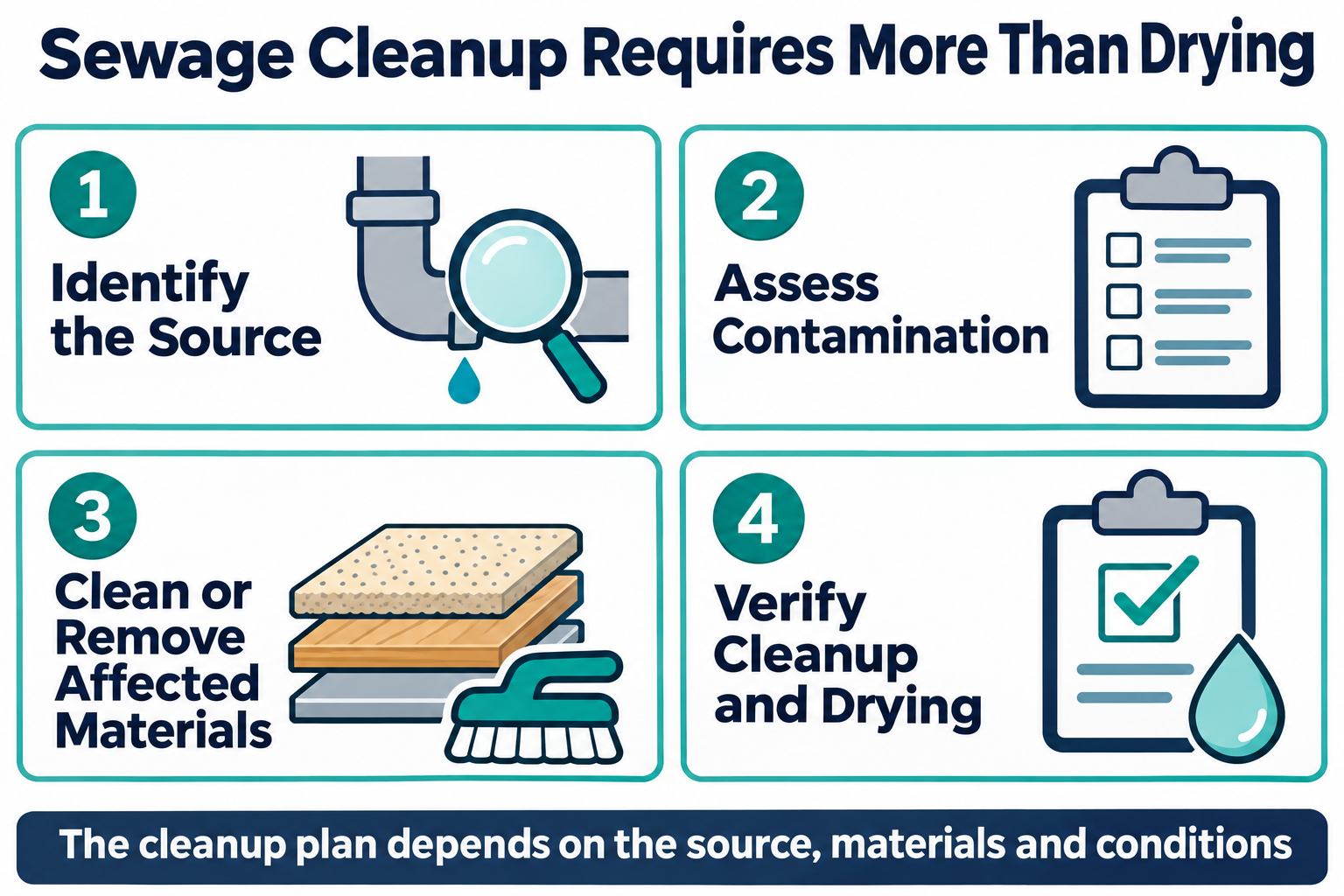
A useful plan describes the affected area, the proposed sequence, the materials involved, and how completion will be evaluated. The exact methods depend on the building and contamination. The following questions give property owners a practical way to review that plan.
1. Where Did the Water Travel?
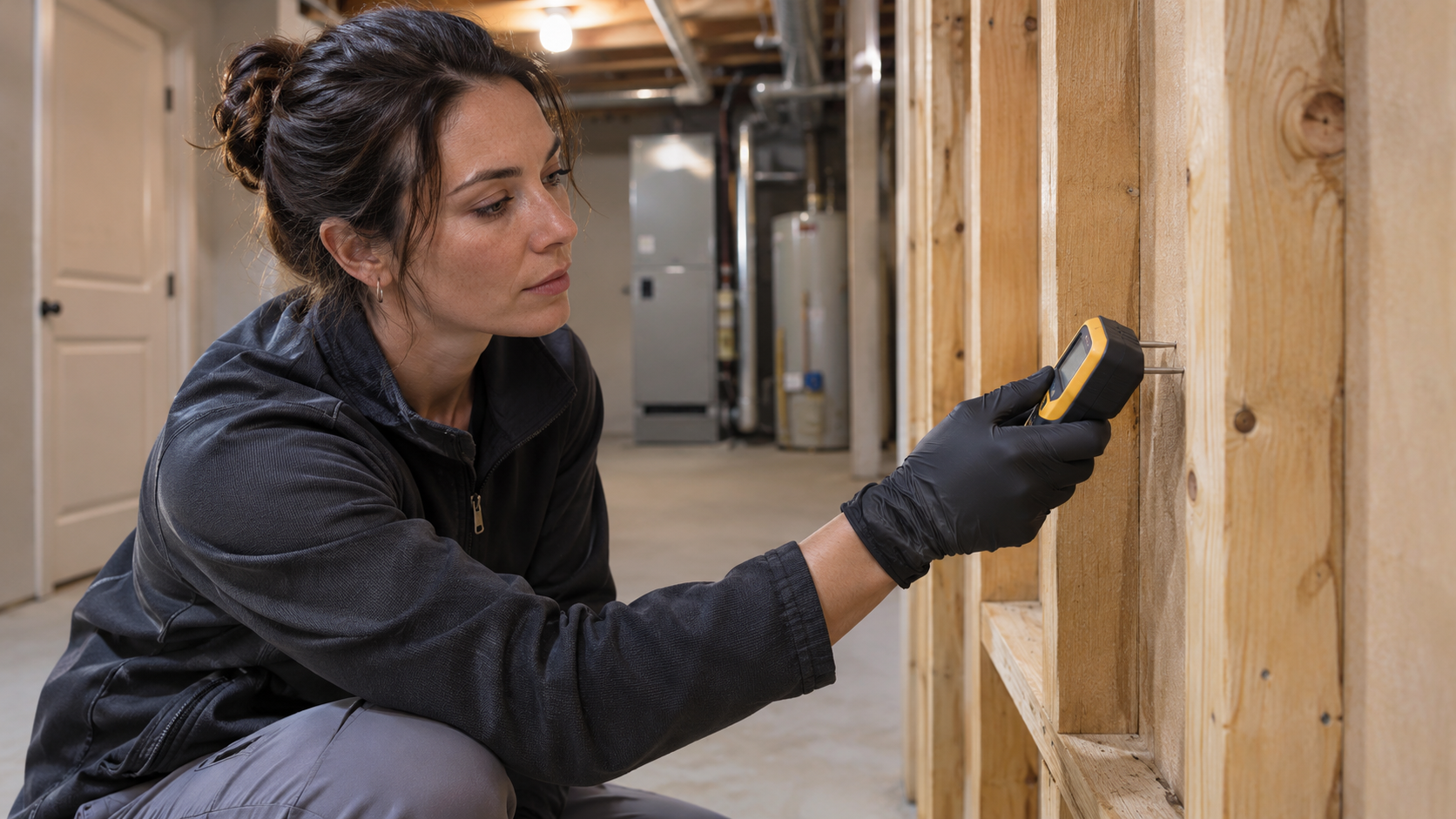
The visible puddle is a starting point, not necessarily the boundary. A contractor should consider adjacent rooms, flooring transitions, wall bases, accessible cavities, and areas below the release. Water can disappear beneath a finish while leaving little visible evidence on top.
Ask which areas were inspected and which remain inaccessible. If a closet could not be evaluated because of stored belongings, that limitation belongs in the record. A preliminary estimate should allow for discoveries rather than implying that hidden conditions have already been ruled out.
2. How Will Unaffected Areas Be Protected?
Discuss access routes, barriers, removal paths, equipment placement, and how workers transition between dirty and clean areas. In an occupied house, those details affect ordinary activities such as reaching bedrooms, doing laundry, or taking a dog outside.
CDC recommends protective boots, gloves, and eye protection when sewage is involved. A professional employer’s hazard assessment may call for additional protection and respiratory controls. A disposable mask alone does not make sewage cleanup suitable for an untrained occupant. [4]
3. Which Materials Can Be Cleaned, and Which Need Removal?
Request an explanation by material or assembly. “Treat the floor” leaves too many unanswered questions. Does the scope include the carpet, pad, tack strips, transitions, subfloor, and the lower wall edges? If something will remain, what makes cleaning and evaluation feasible?
This conversation should include possessions as well as the building. Flag a sentimental item early so a specialist can assess realistic options. A meaningful photograph or heirloom deserves a deliberate decision before it is placed in a disposal pile.
4. How Will Cleaning and Disinfection Be Performed?
EPA recommends physically cleaning flood-contaminated surfaces before using a suitable disinfectant. Soil can interfere with treatment. Some products are intended only for particular surfaces, and many are unsuitable for absorbent materials. [5]
For an EPA-registered disinfectant, the label governs permitted uses, application instructions, and contact time. The required wet contact period is part of treatment; spraying and immediately wiping is not an interchangeable procedure. Do not mix cleaning chemicals. [6]
Ask how those instructions fit the surfaces being retained. A product name or a statement that the crew will “sanitize everything” is less informative than a description of what will be cleaned and how.
5. How Will Drying and Completion Be Documented?
The ANSI/IICRC S500 standard covers professional water-damage restoration, including inspection, drying, safety, materials, and project documentation. It is a technical standard, not a promise that every job has the same equipment list or completion date. [7]
Request the drying goals, relevant measurements, and a clear record of remaining work. Ask whether the contractor’s completion refers to cleanup only or also includes replacement flooring, wall repair, paint, and other reconstruction.
Can Carpet, Drywall, Wood, and Concrete Be Saved?
The useful question is not simply whether an object got wet. It is whether contamination can be removed from the entire affected material or assembly and whether the remaining material is suitable for restoration.
| Material | Common Assessment Issue After Sewage Contact |
|---|---|
| Carpet and cushion | Contamination can reach backing, pad, and the surfaces below; directly affected material often needs disposal |
| Drywall and insulation | Absorption and concealed spaces can make affected portions impractical to clean |
| Concrete and masonry | Durability may allow retention, but cracks, coatings, joints, and soil still need evaluation |
| Structural wood | Access, surface condition, contamination depth, and structural integrity affect the decision |
| Cabinets and composite materials | Swelling and inaccessible joints can limit cleaning and reuse |
| Hard household objects | Material compatibility and access to every contaminated surface matter |
| Mattresses and upholstered furniture | Deep absorbent layers can prevent reliable restoration after direct contamination |
EPA’s flooded-home resources address sorting belongings and removing materials that cannot be adequately cleaned and dried. Do not interpret a washable outer cover as proof that a contaminated cushion or mattress underneath is recoverable.
Material labels can also hide complexity. A “tile floor” includes grout, adhesive, underlayment, transitions, and the substrate below. A “wood cabinet” may have a composite base and an inaccessible cavity underneath. A responsible decision considers the assembly rather than only the visible finish.
Before disposal, document an item’s identity, location, condition, and reason for removal when safe and practical. Ask the insurer about its documentation requirements. Do not keep contaminated possessions in occupied rooms merely to preserve claim evidence.
What If Sewage Reached Walls, Crawlspaces, or HVAC Equipment?
Hidden or difficult access can change both the work and the estimate. A crawlspace may need a separate entry plan. A wall cavity may require controlled opening. A mechanical area may involve equipment that should remain off until an appropriate specialist evaluates it.
If water contacted a furnace, air handler, return opening, duct insulation, or other HVAC component, tell the cleanup team. Have a qualified specialist assess affected equipment before operation. A household filter change does not answer whether contaminated water reached internal components.
Likewise, an air purifier is not a substitute for removing residue from a wet floor assembly. Air questions and material questions overlap, but they require different observations. Denver Decon’s indoor air quality assessment services can be discussed when there is a specific reason to investigate air conditions.
Ask the contractor to identify what is known, what is suspected, and what will require opening or specialist review. That distinction makes a proposal more useful than an assurance that every possible problem is already covered.
Will Mold Grow After a Sewage Backup?
Any unresolved moisture problem can create conditions for mold. Sewage contamination also needs attention before mold becomes visible. Waiting for a musty smell or a patch of growth postpones assessment of a problem that already exists.
CDC recommends cleaning and drying a water-damaged home as quickly as possible, ideally within 24 to 48 hours where feasible. That is an urgency guideline, not a safe waiting period or a guarantee that a room will be restored in two days.
In Denver, outdoor conditions do not tell you whether a wall cavity or covered subfloor has dried. A room can feel comfortable while concealed materials remain wet. The practical response is to evaluate the actual materials rather than assuming Colorado’s climate will finish the work.
If growth is discovered, ask whether the scope needs to expand. Denver Decon provides mold removal and remediation and mold testing and analysis. Sampling should answer a defined question; it does not replace addressing visible damage, sewage residue, or the moisture source.
Why Odor Is an Unreliable Completion Test
Smell can identify a concern, but it cannot map every contaminated surface or prove that cleanup succeeded. Fragrance can temporarily change what you notice. A persistent odor may also have a different source from the original release.
For example, Denver’s wastewater FAQ notes that a dry drain trap can allow sewer odors indoors. That possibility deserves plumbing evaluation; it does not establish that a previously flooded floor is clean. Conversely, odor disappearing does not establish that hidden materials are dry. [3]
A useful follow-up question is: “What evidence supports the source of this odor?” Repeating deodorizing treatments without revisiting the source can leave the owner paying for an unresolved problem.
For a broader explanation of contamination sources, see Denver Decon’s guide to what biohazards are and its overview of indoor airborne contaminants.
Colorado Buildings May Need Additional Planning Before Removal
Some water-damaged finishes can present additional hazards when disturbed. Asbestos-containing materials and older painted surfaces deserve attention before demolition begins. Do not pull up suspect flooring or cut into walls simply because the material is already wet.
Boulder County’s flood-recovery guidance discusses asbestos considerations in flood-damaged buildings. Applicable inspection, removal, and disposal requirements should be confirmed for the particular Colorado project before disturbing suspect materials.
This is a coordination issue for the scope. Ask who will evaluate suspect materials, whether a specialist is needed, and how that affects access and scheduling. An initial cleanup estimate may identify this as a condition to resolve rather than include an unknown abatement project.
For rental properties, assign one person to coordinate owner authorization, contractor access, tenant updates, and claim records. Tenants should receive practical instructions about restricted areas and facilities they can use. Questions about habitability, notice, or legal responsibility should be addressed with appropriate local guidance for the situation.
What Determines Sewage Cleanup Cost and Timeline?
A useful estimate begins with the actual loss. Square footage is relevant, but two equal-sized rooms can require very different work. One may have an accessible concrete floor; the other may have carpet, cabinets, finished walls, stored possessions, and contamination beneath several layers.
Cost and scheduling can be affected by the extent of migration, material removal, contents handling, access, utility safety, specialist involvement, documentation, and reconstruction. An active backup also changes planning because the source remains unresolved.
Ask for the proposal to distinguish initial response, assessment, removal and cleaning, drying, specialist work, and repairs. Clarify which amounts are firm, which are preliminary, and what would trigger a change. Request photographs or an explanation before additional work is authorized when conditions allow.
A practical example: one estimate includes removal of contaminated cushion and assessment of the subfloor; another includes extraction and carpet cleaning only. Those are different scopes. Comparing totals without comparing the underlying work can make the more limited proposal look artificially economical.
Timeline questions should be equally specific. Ask when assessment can occur, what must happen before removal starts, how progress will be checked, and who decides when rebuilding can begin. No reliable universal drying period fits every sewage loss.
Does Insurance Cover Sewage Backup Cleanup?
Coverage depends on the cause, policy language, endorsements, limits, exclusions, and deductible. Do not assume that every event described as “water damage” is covered the same way.
The National Association of Insurance Commissioners identifies sewer-backup coverage as a common optional addition to homeowners insurance. Ask your insurer whether your policy includes applicable coverage and what limits apply.
Flood insurance is a separate issue. FEMA’s National Flood Insurance Program explains that sewer backup is covered under its policy only when directly caused by a qualifying flood; a clog-related backup is not automatically a flood-insurance claim.
Prepare a short claim file containing the discovery timeline, photographs taken safely, plumbing findings, contractor estimates, communications, invoices, and an inventory of affected belongings. Ask separately about temporary living arrangements, contents, cleanup, and reconstruction. Approval of one item does not answer every coverage question.
Keep records factual. If the source has not been confirmed, write “water emerged from the basement floor drain” rather than guessing which pipe failed. Necessary mitigation and insurance review should be coordinated so that documentation does not become a reason for avoidable delay.
How Do You Know the Cleanup Is Complete?
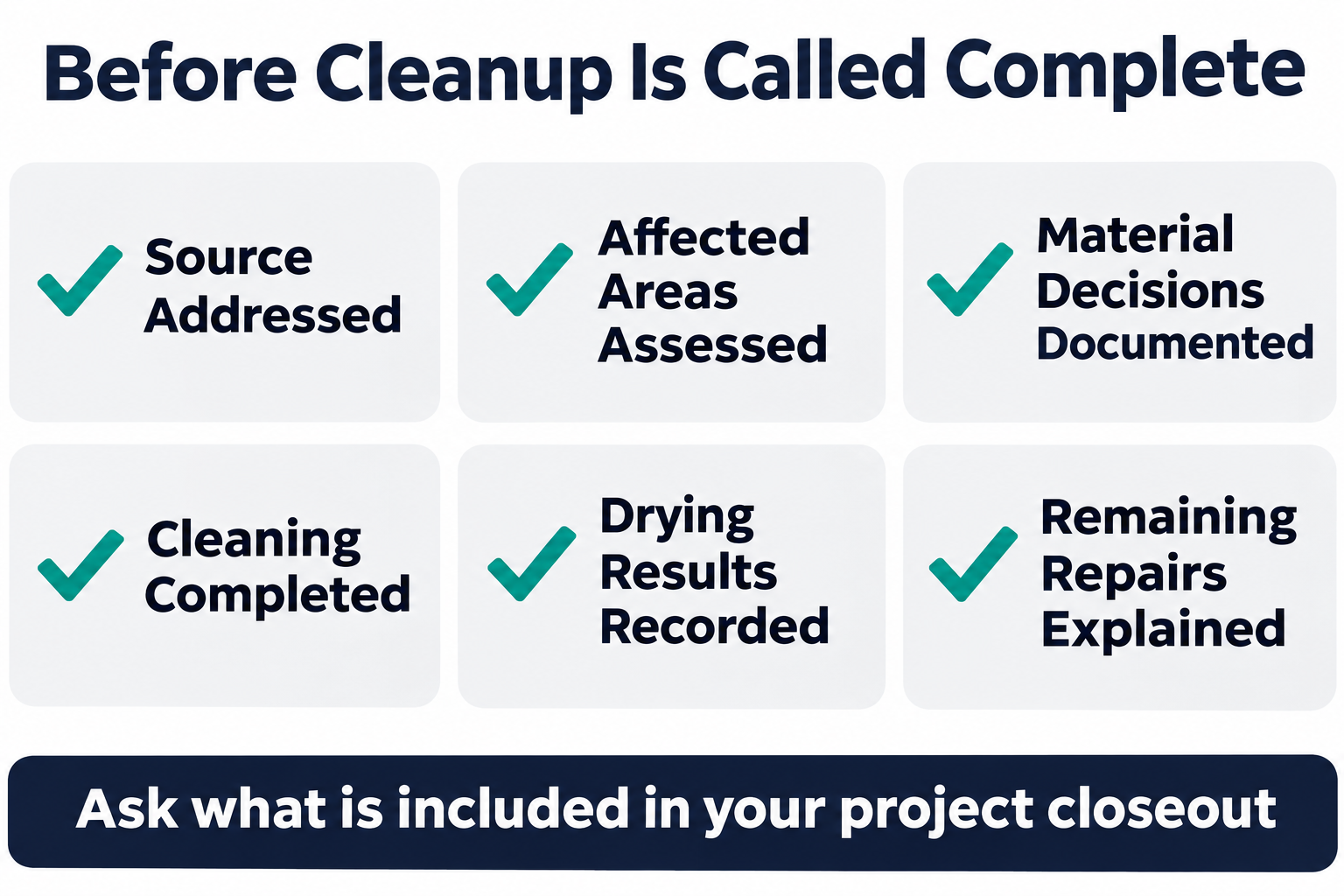
Before work begins, agree on what the contractor will provide at completion. A useful closeout explains the source status, affected areas, removed materials, retained materials, cleaning performed, drying results, limitations, and remaining repairs.
Verification should fit the project. A dry reading cannot establish disinfection, and a single environmental sample cannot certify every surface in a building. If specialist assessment or sampling is proposed, ask what question it answers and how the result will affect decisions.
For a finished basement, discuss the handoff to reconstruction. Who confirms that it is appropriate to install new flooring? Who handles replacement insulation or drywall? If a plumber must return to address recurring drainage symptoms, make that responsibility explicit.
For property managers, keep the completion record with maintenance documentation so the next person can understand what happened. A clear record is especially helpful when future staining, odor, or a new backup must be distinguished from the original incident.
Three Common Assumptions That Complicate Cleanup
“The plumber fixed it, so the room is ready.” Repairing the source is an essential milestone. It does not describe the condition of the floor, contents, or concealed materials affected before the repair. Ask for separate confirmation of the source work and the building work so neither falls between providers.
“The smaller estimate must cover the same result.” Compare the spaces, layers, and tasks included. One proposal might cover the utility room but leave the adjoining storage area unassessed. Another might include disposal but omit rebuilding. List those differences before deciding which proposal fits the property.
“Every remaining question needs a laboratory test.” Start by identifying the decision. If the question is whether a cabinet base was reached, inspection and access may be the next step. If the concern is a specific contaminant or a medically vulnerable occupant, specialist input may be appropriate. Ask how the proposed investigation will change the plan.
These examples share one practical lesson: a clear explanation of the work is part of the service. It helps you understand the estimate, communicate with an insurer, and coordinate repairs. You should be able to identify who owns each next step without deciphering a list of equipment names.
How Denver Decon Fits Into Your Next Step
Denver Decon works with contamination and indoor-environment concerns across the metro area. Review the company’s background, describe the incident, and ask which assessment and cleanup services fit your situation. Confirm the property location and current conditions when arranging assistance.
How Can You Reduce the Chance of Another Backup?
Prevention should follow the diagnosed cause. Ask the plumber whether the problem involved a blockage, roots, a damaged service line, a pump issue, or a public-system event. Request findings in writing when possible.
Discuss whether maintenance, repair, or an approved backwater protection device is appropriate for your property. These decisions depend on plumbing design and local requirements. A device is not a substitute for understanding the cause or maintaining the system.
Keep wipes, grease, and other inappropriate materials out of drains. Denver specifically warns against flushing wipes and pouring grease into the sewer system. [3]
Move important records and vulnerable belongings away from the lowest storage locations where practical. Keep the utility’s reporting information, a plumber’s number, insurance details, and cleanup contact information together. Those small preparations make a stressful discovery easier to manage.
Denver Decon’s decontamination and remediation service overview can help owners identify related concerns to mention when arranging an assessment.
Frequently Asked Questions About Sewage Cleanup
Is sewage cleanup the same as ordinary water-damage cleanup?
Sewage cleanup must address contamination as well as moisture. It can require controlled access, removal of affected absorbent materials, cleaning, suitable disinfection, and documented drying.
Can clear-looking water from a drain still be contaminated?
Yes. Appearance does not establish safety. The source, its path through the building, and the materials it contacted need assessment.
Should I use fans after a sewage backup?
Do not aim household fans across sewage-contaminated materials. Have the responding contractor assess contamination controls and determine an appropriate drying plan.
Can sewage-soaked carpet be cleaned and reused?
Directly contaminated carpet and cushion often need removal. The assessment should also consider the subfloor and adjacent materials; surface carpet cleaning alone does not resolve the entire loss.
Does bleach fix sewage contamination?
Bleach alone is not a complete cleanup method. Physical cleaning, material decisions, product suitability, label directions, and drying all matter. Never mix cleaning products.
Do I need a plumber and a cleanup contractor?
You may need both. Plumbing or utility work addresses the source, while cleanup addresses the affected building and belongings. Confirm each provider’s responsibilities.
How long does professional sewage cleanup take?
There is no universal timeline. The affected area, materials, access, source repair, drying conditions, specialist work, and reconstruction requirements determine the schedule.
Will homeowners insurance pay for a sewer backup?
Coverage depends on the policy and cause. Ask your insurer about applicable water-backup endorsements, limits, exclusions, deductibles, and documentation requirements.
Does the house have to be empty during cleanup?
Occupancy depends on the affected area, available facilities, work controls, and occupant needs. Ask the contractor whether unaffected rooms can remain in use and what restrictions are needed.
Who can assess sewage contamination in the Denver area?
Contact Denver Decon at 720-825-2130 to discuss the affected property and arrange the next assessment step. Report utility-related backups to the sewer provider serving your address.
What You Should Do Next
A sewage backup can interrupt everything you were planning to do today. You may be trying to protect your family, answer a tenant, save belongings, and figure out who to call—all before you know how far the water traveled. You do not have to solve every part at once.
Start by keeping the affected area off limits and arranging help for the source. Then request an assessment that explains the contamination, material decisions, and next steps in plain language. Acting promptly gives the responding professionals a better opportunity to evaluate conditions before damage becomes harder to trace.
Contact Denver Decon or call 720-825-2130. Share your location, where the backup appeared, whether it is continuing, and the rooms or materials you believe are affected. Ask what the initial assessment includes and how the proposed work will be documented.
The goal is a clear path from the first inspection through cleanup, drying, and any needed repairs—so you can make informed decisions and move toward using your property with confidence again.
Authority and Safety References
-
- IICRC: Category of Water Damage and Weather-Related Events, 2026 position statement
- CDC: Floodwater Safety
- City and County of Denver: Wastewater Questions and Answers
- CDC: Cleaning Safely After a Disaster
- EPA: Flood Cleanup to Protect Indoor Air and Your Health
- EPA: Selected EPA-Registered Disinfectants
- IICRC: S500 Standard for Professional Water Damage Restoration
- EPA: Flooded Homes—Additional Resources and Help
- CDC: Dry Off Wet Items After a Storm
- Boulder County: Flood Recovery Resources
- NAIC: Homeowners Insurance
- FEMA/NFIP: Buy a Flood Insurance Policy