
After an injury, accident, or traumatic event, the instinct to restore a room quickly is understandable. A homeowner wants the house to feel normal again. A business needs to protect employees and customers. A landlord or facility manager needs to know when a space can be used again.
Reaching for disinfectant may seem like the obvious first step. But blood cleanup requires more than choosing a chemical that can kill germs. It also requires identifying where blood traveled, removing contamination, protecting the people doing the work, treating suitable surfaces correctly, and managing the resulting waste.
Some household disinfectants can be useful when their EPA-registered labels support the intended use. The limitation is that a bottle cannot assess carpet padding, find contamination beneath flooring, handle broken glass, or establish whether a cleanup is complete.
The most important question is not just “What disinfectant should I use?” It is “Where did the blood go, and can every affected material be effectively cleaned and treated?”
Blood Cleanup Is a Process, Not Just a Product
Three related tasks are often mistaken for the same thing:
- Cleaning physically removes blood, residue, and other soil.
- Disinfection treats appropriate surfaces with a product used according to its pathogen-specific label directions.
- Remediation addresses the wider incident, including affected materials, exposure precautions, contamination transfer, and waste.
CDC’s healthcare environmental guidance explains that organic material can interfere with disinfection and supports removing blood and cleaning before final surface disinfection. Spraying over a visible spill is therefore an incomplete approach. CDC
For property owners, the practical lesson is straightforward: treating an accessible surface does not remove contaminated material underneath it.
Why a Household Disinfectant Can Fall Short
The Label May Not Cover the Intended Use
A general germ-killing claim does not establish suitability for blood contamination. EPA’s current List S identifies registered products with claims against HIV, hepatitis B, or hepatitis C. A listed product may cover only some of these pathogens, and contact times can differ. US EPA
Check the actual label for the relevant pathogen claims, permitted surface and setting, cleaning requirements, dilution if applicable, and contact time. A hard-surface claim does not establish that the product can disinfect carpet padding or mattress foam.
Wiping Too Soon Can Defeat the Treatment
Contact time is the required period the treated surface must remain visibly wet. A quick mist followed by immediate wiping may not satisfy the product’s directions. There is no universal contact time for every disinfectant. US EPA
Blood May Be Beyond the Product’s Reach
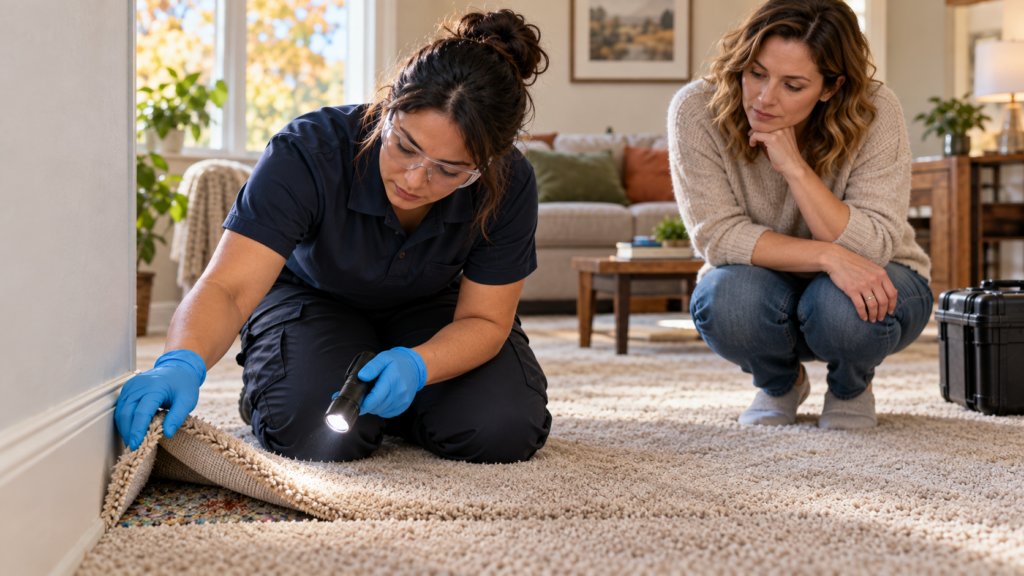
Picture a spill at the edge of a carpeted room. The visible mark is on the fibers, but the assessment may need to include the backing, padding, flooring underneath, and nearby trim.
Likewise, blood beside a cabinet can enter the joint at its base. Blood on an upholstered chair can reach a cushion through fabric or a damaged cover. These practical examples illustrate why the visible stain may understate the cleanup scope.
CDC’s healthcare guidance identifies carpeting as harder to clean after blood spills and describes limitations to its decontamination. CDC
For a home or commercial property, material decisions should follow the actual extent of contamination and available treatment options. Some affected materials may need removal. Automatically replacing an entire room without assessment is also poor decision-making.
Also Read 👉🏻How Do Buyers Discover Meth Contamination During Home Inspections?
Dried Blood Is Not Proof That the Hazard Has Passed
Blood can carry pathogens, but a blood spill does not mean the person involved has an infection. Precautions should protect everyone without making assumptions about anyone’s health.
Drying alone does not establish safety. CDC states that hepatitis B virus can remain infectious on surfaces for at least seven days. Transmission involves an exposure route, such as a puncture, mucous membrane contact, or contact with nonintact skin. Simply being in a room is not equivalent to such an exposure. CDC
The sensible response is careful handling and appropriate cleanup, rather than guessing from a stain’s age, color, or dryness.
Also Read 👉🏻How Do You Know If a Cleanup Company Is Actually Qualified?
When Professional Blood Cleanup Makes Sense
A few drops from a minor injury on an intact, nonporous surface are different from an extensive spill or blood absorbed into building materials. Workplace procedures and the responder’s training still matter, even for a contained incident.
Seek professional assessment when:
- Blood has soaked into carpet, upholstery, mattresses, unfinished wood, or other absorbent materials.
- Contamination may have entered flooring seams, trim joints, or inaccessible spaces.
- There are needles, broken glass, or other suspected sharps.
- The affected area is extensive, involves several surfaces, or has an uncertain boundary.
- Footwear, objects, or earlier cleaning attempts may have spread contamination.
- The incident involves an unattended death or significant trauma.
- Available responders lack suitable training, protective equipment, or a waste-management plan.
A useful way to decide is to assess reach, spread, and readiness:
- Reach: Can every affected surface and material be accessed?
- Spread: Is contamination contained, or is its boundary uncertain?
- Readiness: Is a suitable response available?
This is a practical decision aid, not a regulatory threshold. It avoids treating the size of the visible stain as the only factor.
Also Read 👉🏻What Role Do Air Scrubbing, VOC Control, and CLO₂ Play in Meth Remediation?
What Homeowners, Businesses, Landlords, and Facility Managers Should Consider
| Audience | Immediate Priority | Question to Resolve |
|---|---|---|
| Homeowners | Keep children, pets, and visitors away. | Did blood enter absorbent materials or inaccessible places? |
| Businesses | Restrict traffic and activate incident procedures. | Who is trained and authorized to respond? |
| Landlords | Coordinate access and protect residents’ privacy. | What needs assessment before repairs or occupancy decisions? |
| Facility managers | Separate the affected area from normal operations. | What documentation and operational approvals are needed? |
A homeowner may be coping with the event itself as well as the room it affected. Choosing professional help can reduce that burden without requiring the family to handle contaminated belongings.
For a business, a short interruption should not become an improvised assignment for the nearest employee. For a landlord, replacing carpet over an unassessed substrate can conceal an unresolved problem. For a facility manager, the incident plan should identify who controls access, who performs cleanup, and who authorizes the next phase.
Employers Have Responsibilities Before Assigning Cleanup
OSHA’s Bloodborne Pathogens Standard applies to occupational exposure to blood or other potentially infectious materials. It is not a blanket requirement that every household blood spot be handled by a commercial cleanup company. Occupational Safety and Health Administration
When employees have occupational exposure, applicable employer responsibilities include an exposure-control plan, appropriate controls and protective equipment, training, offering hepatitis B vaccination, and post-exposure evaluation and follow-up. Calling someone a cleaner, maintenance worker, or facility employee does not replace those protections. osha.gov
A contractor can address the cleanup scope. The employer still needs to manage its own staff, reporting, and exposure response.
What to Do Before Cleanup Begins
- Address the emergency first. Call 911 if someone needs emergency medical help or there is an immediate threat.
- Restrict access. Keep people and pets from crossing or touching the affected area.
- Respect any investigation. If authorities control the scene, wait for their release before disturbing it.
- Avoid spreading the material. Leave affected objects in place for assessment. Do not use a household vacuum or routine carpet machine on the contamination.
- Arrange a suitable response. Use the workplace’s trained response personnel or contact a professional when the scope or safe handling is uncertain.
If blood contacted your eyes, mouth, broken skin, or a puncture wound, promptly seek medical evaluation. CDC recommends washing wounds and skin with soap and water, flushing splashes, and irrigating eyes with clean water or saline. Employees should report an exposure immediately so appropriate follow-up can be arranged. CDC
👀IAQ Testing Services
What a Thorough Professional Cleanup Should Address
When discussing a project with a provider, ask how the proposed work covers these elements:
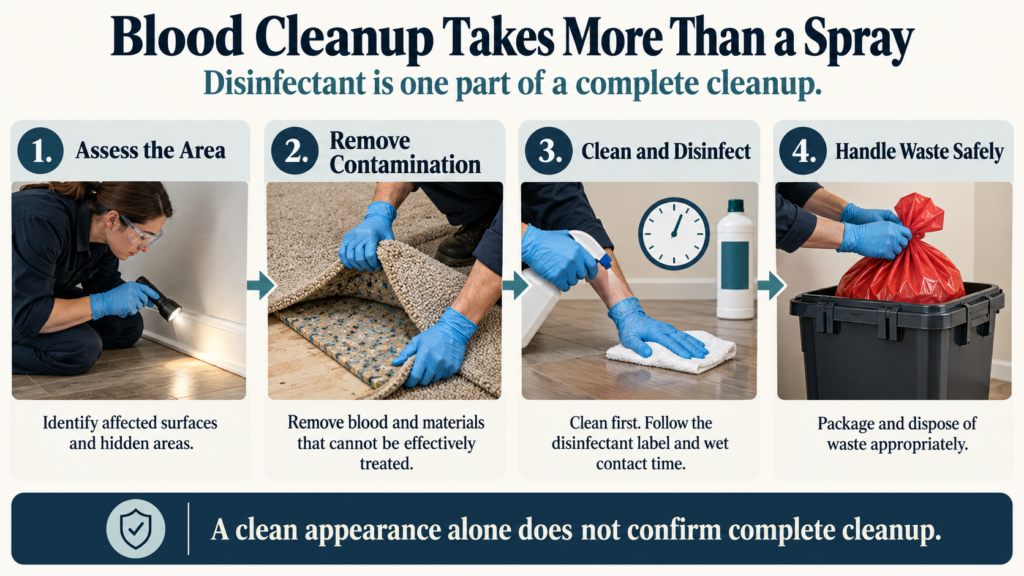
- Assessment: Identify affected surfaces, material layers, possible transfer, and suspected sharps.
- Work-area control: Establish access limits and precautions suited to the incident.
- Contamination removal: Remove blood and material that cannot be effectively cleaned and treated.
- Cleaning and disinfection: Treat remaining suitable surfaces according to the selected product’s label.
- Waste handling: Package and route waste according to its classification and applicable requirements.
- Documentation: Explain what was addressed, what was removed, and what remains outside the scope.
Cleanup and reconstruction are separate phases. An area may still need flooring, drywall, or furniture replacement after contamination has been addressed. Ask who is responsible for those repairs and when the space can return to its intended use.
Completion should be supported by the scope and work records. A fresh smell is not a verification method, and any testing should be explained in terms of what it can actually demonstrate.
Also Read 👉🏻How Can Hidden Odors Destroy Property Value and Tenant Retention?
Why Waste Handling Is Part of the Job
Cleanup creates waste as well as a cleaner surface. Saturated absorbent material, contaminated sharps, and some dried-blood debris need different handling from ordinary refuse.
OSHA’s regulated-waste definition includes liquid blood, materials that release blood when compressed, certain dried-blood materials, and contaminated sharps. It does not classify every item with a tiny blood mark identically. Occupational Safety and Health Administration
Colorado’s public-health department provides guidance for household medical waste and trauma-scene waste management. Colorado Department of ... Ask the provider how the project’s waste will be classified, packaged, and disposed of. A red bag by itself does not make disposal appropriate.
Common Blood Cleanup Myths
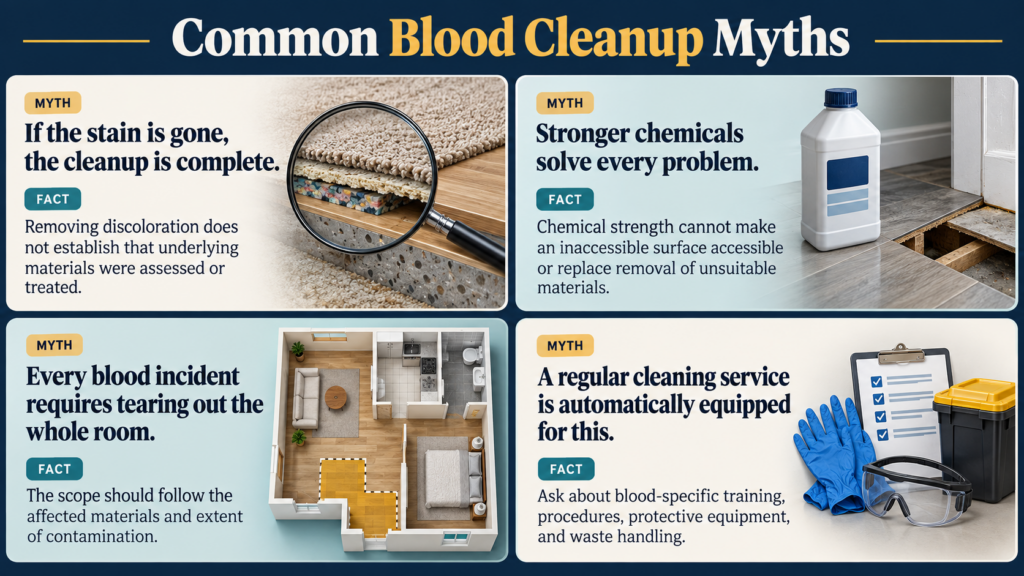
“If the stain is gone, the cleanup is complete.”
Removing discoloration does not establish that underlying materials were assessed or treated.
“Stronger chemicals solve every problem.”
Chemical strength cannot make an inaccessible surface accessible or replace removal of unsuitable materials.
“Every blood incident requires tearing out the whole room.”
The scope should follow the affected materials and extent of contamination.
“A regular cleaning service is automatically equipped for this.”
Ask about blood-specific training, procedures, protective equipment, and waste handling.
What Affects Blood Cleanup Cost and Timing?
The useful starting point is an assessment, rather than a price based only on the visible spot. Scope can depend on the affected area, material layers, access, contents handling, waste logistics, prior attempts, and documentation needs.
Ask for a written scope identifying cleanup, disposal, and any excluded repairs. If insurance may apply, report the incident and ask what records the insurer needs. Coverage depends on the policy and circumstances; payment is not guaranteed.
Also Read 👉🏻How Can Hidden Odors Destroy Property Value and Tenant Retention?
Frequently Asked Questions
Can Household Disinfectant Kill Bloodborne Pathogens?
Some EPA-registered products have relevant bloodborne-pathogen claims when used exactly as labeled. That does not make a spray-and-wipe approach adequate for absorbed blood, hidden contamination, sharps, or waste handling. US EPA
Does Dried Blood Still Need Careful Cleanup?
Yes. Drying does not reliably establish safety. CDC notes that hepatitis B virus can remain infectious on surfaces for at least seven days. Treat unidentified human blood cautiously. CDC
Is Bleach Enough for Blood Cleanup?
An appropriate EPA-registered bleach product may be part of a cleanup procedure. It does not replace assessment, removal of blood and contaminated materials, correct contact time, or suitable disposal.
Does Every Small Blood Spot Require a Professional?
No. A few drops from a minor injury on an intact, nonporous surface differ from a substantial or absorbed spill. Workplace cleanup should follow applicable exposure-control procedures and be performed by appropriately trained personnel.
Can Blood-Contaminated Carpet Be Saved?
That depends on the extent of contamination, the materials involved, and what can be effectively treated. A surface stain does not reveal whether blood reached the backing, padding, or subfloor. Professional assessment may identify material that needs removal.
Can a Landlord Ask a Tenant or Maintenance Worker to Clean It?
Do not assume either person can safely handle the situation. Assess the contamination and the person’s training and equipment. Employers must address applicable occupational-exposure obligations before assigning cleanup to employees. osha.gov
Can a Regular Janitorial Company Handle Blood Cleanup?
Some providers have trained staff and suitable procedures for contained incidents. Routine janitorial service alone does not establish competence for absorbed blood, extensive contamination, sharps, or trauma-scene waste.
Does a Clean Appearance or Fresh Smell Prove the Area Is Safe?
No. Appearance and smell cannot establish that contamination was removed or disinfectant directions were met. Ask what was inspected, treated, removed, and documented.
Will Property Insurance Pay for Professional Blood Cleanup?
Coverage depends on the policy, cause of loss, exclusions, deductible, and insurer’s decision. Report the incident and ask what documentation is needed without assuming payment is guaranteed.
What Should I Tell Denver Decon When I Call?
Describe the location, affected surfaces, approximate extent, suspected sharps, previous cleaning attempts, and whether authorities still control the area. Share photographs only if you can take them safely and privately.

What to Do Next. . . A Safer Next Step Starts With an Assessment
You do not have to decide which materials can be saved or take on an unfamiliar cleanup alone. Contact Denver Decon to discuss the affected area and an appropriate next step.
Office: 720-825-2130
Cell: 720-329-7769
denverdecon.com