

Why Isn’t Air Quality Testing Alone Enough After Biohazard Cleanup?
Air quality testing alone cannot confirm full biohazard remediation. While tests measure airborne particles at a moment in time, contaminants can remain hidden in HVAC systems, porous materials, and building cavities—posing ongoing health and liability risks.
Passing the Test Doesn’t Mean the Problem Is Gone
Air quality testing has become the gold star many property owners and insurers look for after a biohazard cleanup. A clean report feels like closure. Numbers look good. The space is reoccupied.
Then symptoms return. Odors resurface. Complaints start.
The uncomfortable truth is this: air quality testing is a snapshot, not a diagnosis. It measures what’s floating in the air at that exact moment—not what’s embedded, dormant, or waiting for the HVAC system to kick on.
Testing is valuable. But testing alone is not remediation.
What Air Quality Testing Actually Measures
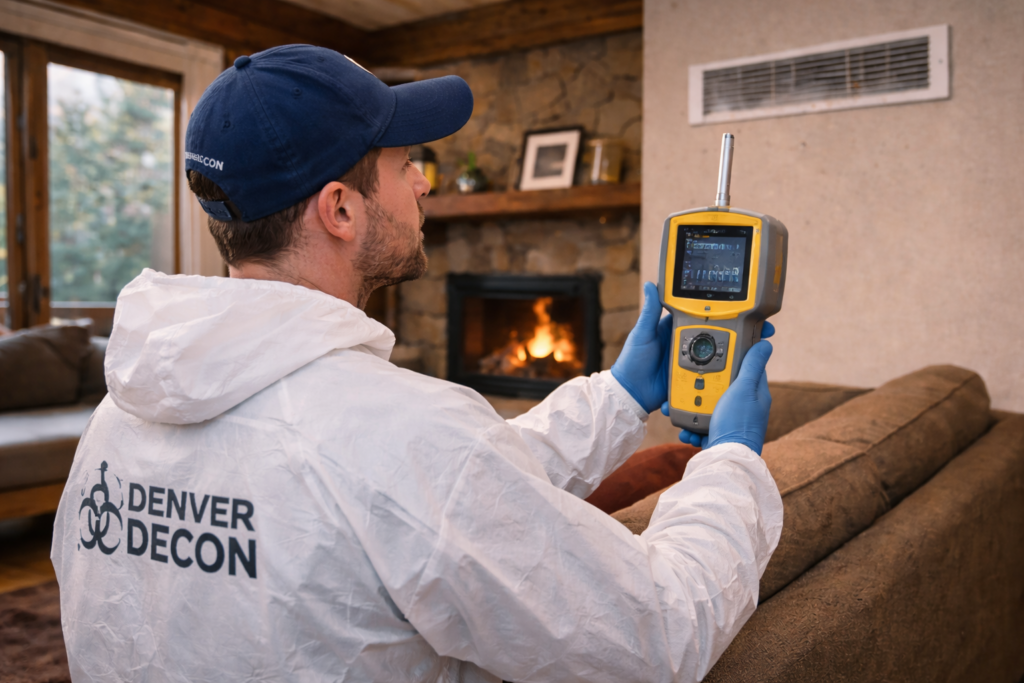
Most post-remediation air testing evaluates:
- Airborne particulate levels
- Mold spore counts
- Volatile organic compounds (VOCs)
- Comparative indoor vs. outdoor air samples
These tests answer a narrow question:
“What is in the air right now?”
They do not answer:
- What’s inside ductwork
- What’s embedded in porous materials
- What becomes airborne when conditions change
- What reactivates with humidity, airflow, or occupancy
This limitation is structural, not procedural.
The Timing Trap: Why Clean Results Can Be Misleading
Air testing is often performed:
- After cleaning but before HVAC reactivation
- During low-occupancy periods
- Under controlled conditions
- Before materials fully dry or equilibrate
In these moments, contaminants may not yet be airborne. That doesn’t mean they’re gone. It means they’re temporarily quiet.
Once temperature, airflow, or humidity shifts, previously settled contaminants can re-enter circulation.
Passing early doesn’t mean staying clean.
Hidden Reservoirs Testing Can’t See
Biohazard contamination is rarely confined to open air. Common reservoirs include:
- HVAC duct interiors and air handlers
- Fiberglass insulation
- Wall cavities and ceiling plenums
- Upholstery, carpets, and soft furnishings
- Subflooring and building materials
Air tests don’t sample these areas. They assume removal occurred correctly.
Assumption is not verification.
HVAC Systems: The Blind Spot in Most Testing Protocols
As covered in Article #12, HVAC systems act as force multipliers for contamination. Air testing typically samples room air—not duct interiors.
This creates a dangerous gap:
- Air tests pass
- HVAC turns on
- Contaminants redistribute
- Occupants are exposed
- Liability resurfaces
Without HVAC inspection and cleaning, air testing is incomplete by definition.
Odors: The Canary Testing Often Ignores
Persistent odors after biohazard cleanup are an early warning system. Odors indicate:
- Residual biological matter
- Smoke or decomposition compounds
- Incomplete material removal
Air quality tests may still pass because odor-causing compounds can exist below regulatory thresholds—yet remain perceptible and harmful over time.
Human senses notice what instruments sometimes miss.
Health, Compliance, and Legal Exposure
Relying solely on air testing can create risk across multiple fronts:
- Health: Chronic exposure to low-level contaminants
- Compliance: Failure to meet OSHA or local health expectations
- Insurance: Claim disputes due to incomplete remediation documentation
- Legal: Negligence claims tied to re-exposure
Courts and insurers increasingly look at process completeness, not just test results.
What a Complete Post-Biohazard Verification Looks Like
True remediation verification combines multiple layers:
- Source removal confirmation
- HVAC system inspection and cleaning
- Surface and material decontamination
- Odor neutralization (not masking)
- Air quality testing as final confirmation, not the sole proof
Testing should be the last step, not the only one.
The Bottom Line: Testing Is a Tool, Not a Verdict
Air quality testing is essential—but insufficient on its own. It tells you the air is clean for now. It does not guarantee the building is clean overall.
Biohazard remediation fails when we confuse measurement with elimination.
Clean air today means nothing if contamination is still waiting behind the walls, above the ceiling, or inside the ducts.
FAQs
1. Why can air quality tests pass but problems return later?
Because contaminants may not be airborne at the time of testing.
2. Does air testing detect contamination inside HVAC systems?
No. It samples room air, not duct interiors.
3. Can odors exist even if air tests pass?
Yes. Odors often persist below measurable thresholds.
4. Is air testing required after biohazard cleanup?
Often yes—but it should not be the only verification step.
5. What causes re-contamination after remediation?
Hidden reservoirs, HVAC activation, humidity changes, or incomplete removal.
6. Do insurance companies rely only on air tests?
Increasingly no. They look for full remediation documentation.
7. Can air tests miss mold entirely?
Yes, especially if spores are dormant or settled.
8. Should HVAC cleaning happen before air testing?
Yes. Otherwise test results may be misleading.
9. Is visual cleanliness enough without testing?
No. Visual inspection alone cannot confirm air safety.
10. What’s the safest approach after a biohazard event?
Source removal, HVAC remediation, and air testing together.