
Why “Quick Fix” Thinking Persists—and Why It’s Risky
Meth contamination makes people uncomfortable, and discomfort creates urgency.
Urgency creates a market for shortcuts.
Over the years, air scrubbers, fogging machines, ozone, and CLO₂ have been marketed as solutions that promise speed, simplicity, and reassurance. Some of these tools do have value—but only when their limitations are clearly understood.
The most dangerous myth in meth remediation is not that these tools exist.
It’s the belief that they replace physical remediation.
In Colorado, that belief can derail clearance, stall transactions, and create long-term liability.
Understanding the Difference Between Air Quality and Surface Contamination
One of the most common points of confusion is the difference between:
• Airborne contaminants (VOCs, odors, particulates)
• Surface-bound meth residue
Meth contamination is primarily a surface problem, not an air problem.
Colorado clearance standards measure surface residue, not smell, not comfort, and not air freshness. A property can have excellent indoor air quality and still fail clearance because meth residue remains bonded to walls, trim, cabinets, or HVAC components.
This distinction is foundational.
Also Read 👉🏼Why Isn’t Air Quality Testing Alone Enough After Biohazard Cleanup?
What Air Scrubbing Actually Does—and Does Not Do
Air scrubbers equipped with HEPA filtration are valuable tools during remediation, but their role is specific.
Air scrubbing:
• Captures airborne particulates
• Supports containment
• Protects adjacent spaces
• Reduces cross-contamination risk
Air scrubbing does not:
• Remove meth residue from surfaces
• Decontaminate porous materials
• Replace material removal
• Satisfy clearance requirements
Air scrubbers control movement, not contamination.
Used correctly, they support safe remediation. Used incorrectly, they create false confidence.
VOC Control: Helpful for Comfort, Irrelevant for Clearance
Volatile Organic Compounds (VOCs) are often associated with odors and irritation. After remediation, VOC control can improve perceived air quality and occupant comfort.
However:
• VOC reduction does not indicate meth removal
• VOC testing does not substitute for surface sampling
• VOC results are not used for clearance decisions
In real estate transactions, VOC control may help buyers feel comfortable after clearance—but it does not move a deal forward on its own.
It is a post-compliance confidence tool, not a compliance metric.
CLO₂ (Chlorine Dioxide): Powerful Tool, Narrow Role
CLO₂ is one of the most misunderstood tools in the remediation space.
Used appropriately, CLO₂ can:
• Neutralize odors
• Reduce microbial smells
• Improve post-remediation air quality
• Support buyer confidence
CLO₂ cannot:
• Remove meth residue from surfaces
• Replace material removal
• Alter clearance testing results
• Make a non-compliant property compliant
This matters because CLO₂ is often marketed as a “solution” rather than a supplement.
In regulated meth remediation, CLO₂ belongs after physical remediation and after clearance—not instead of either.
Also Read 👉🏼Is Chlorine Dioxide Safe For Odor Removal?
Why Fogging and Ozone Are Especially Problematic
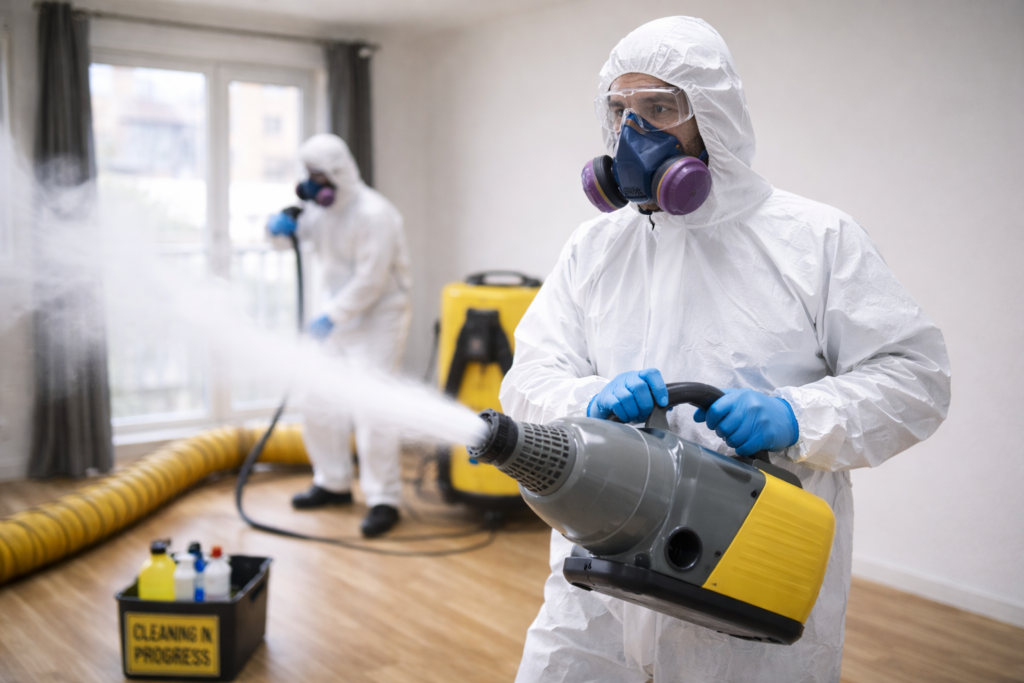
Fogging and ozone treatments are frequently bundled into “quick fix” narratives.
The problems are consistent:
• They do not remove bonded residue
• They can redistribute contamination
• They may create secondary health risks
• They complicate clearance interpretation
In some cases, these treatments make later remediation harder, not easier.
Professional remediation avoids tools that interfere with documentation, testing, or defensibility.
How These Tools Fit Into a Proper Remediation Timeline
In a compliant remediation process, supportive tools are used in specific sequence:
- Containment and negative air control
- Removal of contaminated materials
- Detailed surface decontamination
- HVAC remediation (if required)
- Independent clearance testing
- Post-clearance air quality and odor management (if needed)
When tools like air scrubbers and CLO₂ are used in this order, they add value without creating risk.
When used out of order, they create confusion.
Why Buyers and Inspectors Are Skeptical of “Air-Based” Claims
Experienced inspectors and consultants have seen the pattern:
• Odor removed
• Air smells fresh
• Clearance still fails
This is why claims based solely on air treatment raise red flags during due diligence.
Buyers don’t want a house that feels clean.
They want a house that is provably compliant.
The Role of IAQ Testing After Clearance
Indoor Air Quality (IAQ) testing can be useful after clearance to:
• Support buyer confidence
• Establish baseline conditions
• Address unrelated air concerns
IAQ testing is not a replacement for meth clearance.
It is an adjunct, not a substitute.
Used correctly, it reassures. Used incorrectly, it confuses.
How DenverDecon Uses These Tools Responsibly
DenverDecon integrates air scrubbing, VOC control, and CLO₂ with clear boundaries.
They are used to:
• Support safe remediation
• Protect adjacent spaces
• Improve post-clearance presentation
• Reinforce buyer confidence
They are not used to:
• Shortcut compliance
• Mask contamination
• Replace physical remediation
• Influence clearance outcomes
That distinction is what protects transactions.
Returning the Home to “Normal”
When remediation is complete, clearance has passed, and supportive tools are used appropriately, the result is not a “treated” house.
It is simply:
• Safe
• Compliant
• Calm
• Show-ready
The goal is not to impress buyers with technology.
The goal is to make the remediation invisible.
Also Read 👉🏼What are the Top Contaminates in My Home & How to Get Rid of Them
Conclusion: The Right Tools, the Right Process, and the Right Partner
Air scrubbers, VOC control, and CLO₂ are only effective when they’re used at the right time, for the right reason, and within a process that actually satisfies Colorado’s remediation and clearance requirements. Tools alone don’t create compliance—understanding the system does.
That’s where DenverDecon makes the difference.
DenverDecon helps buyers, sellers, agents, and investors cut through the confusion, understand what actually matters, and move forward with a clear plan. Their approach is built around a tried-and-true remediation process that aligns with CDPHE expectations, works smoothly with independent consultants, and is designed to produce defensible results without unnecessary steps or wasted expense.
Rather than over-treating a property or pushing costly “quick fixes,” DenverDecon focuses on efficiency, accuracy, and outcomes—doing what’s required, documenting it properly, and helping clients navigate the red tape that so often stalls transactions. The goal is simple: restore the property to a compliant, show-ready condition so deals can move forward.
For sellers, that means protecting equity and avoiding drawn-out delays.
For buyers, it means confidence in what they’re purchasing.
For everyone involved, it means accomplishing real estate goals without emptying their pockets or gambling on shortcuts that don’t hold up.
When meth contamination enters the picture, clarity matters. DenverDecon exists to provide it—step by step, start to finish—so properties don’t stay stuck in limbo and people can move on.
(FAQS)
-
Can DenverDecon help me understand what actually needs to be done after meth contamination is found?
Yes. DenverDecon explains the remediation and clearance process clearly, helping buyers and sellers understand what is required, what is optional, and what will actually move the transaction forward. -
How does DenverDecon help cut through regulatory red tape?
DenverDecon works within Colorado’s CDPHE framework and coordinates properly with independent consultants, preventing delays caused by incorrect methods, poor documentation, or unnecessary steps. -
Do I need to do every treatment option I’m being sold to pass clearance?
No. Clearance depends on surface contamination levels, not the number of treatments used. DenverDecon focuses on what is required to pass clearance—nothing more, nothing less. -
Can DenverDecon help speed up the remediation and clearance process?
Yes. By using a proven, step-by-step approach and planning for clearance from the beginning, DenverDecon helps reduce rework, failed tests, and unnecessary delays. -
Does DenverDecon work for buyers as well as sellers?
Yes. DenverDecon supports both sides by focusing on compliance, transparency, and documentation that protects buyers while helping sellers move forward responsibly. -
How does DenverDecon help control costs during meth remediation?
By avoiding over-treatment, eliminating ineffective shortcuts, and targeting remediation where it actually matters, DenverDecon helps clients avoid wasted spending and repeated work. -
Will DenverDecon guarantee a clearance pass?
No contractor can guarantee clearance results, but DenverDecon’s process is designed to align with CDPHE expectations and reduce the risk of failure on the first test. -
Can DenverDecon help if a property has already failed clearance?
Yes. DenverDecon frequently assists with failed-clearance situations by identifying gaps in prior remediation and correcting them efficiently. -
How does DenverDecon support real estate transactions specifically?
DenverDecon understands transaction timelines, lender requirements, and due-diligence pressure, and structures remediation to support defensible clearance documentation. -
What is the main advantage of working with DenverDecon instead of trying to handle it myself?
DenverDecon replaces confusion with clarity—guiding clients through a proven process that protects health, supports compliance, and helps achieve real estate goals without unnecessary financial strain.