
Why Meth Contamination Is a Legal Condition—Not a Cleanup Preference
Meth contamination occupies a rare and uncomfortable space in real estate law. It is not cosmetic. It is not optional. And it is not governed by opinion.
In Colorado, meth contamination is treated as a regulated environmental health condition. Once identified—or reasonably suspected—it triggers statutory obligations that override seller intent, buyer tolerance, and timeline pressure.
This is why meth-impacted properties don’t just “need cleaning.”
They require legal compliance.
Buyers want to know whether they can occupy the property.
Sellers want to know how to move forward without blowing up the deal.
Agents want to know what must be disclosed.
Lenders want to know whether the asset is financeable.
Colorado law answers these questions clearly—though not always simply.
The Governing Authority: CDPHE and Regulation 6 CCR 1014-3
Meth remediation in Colorado is governed by the Colorado Department of Public Health and Environment (CDPHE) under 6 CCR 1014-3, a regulation that establishes:
• Allowable contamination thresholds
• Approved remediation methods
• Clearance testing requirements
• Documentation and record retention standards
This regulation applies statewide and does not distinguish between owner-occupied homes, rentals, flips, or commercial properties.
Once contamination exceeds the allowable limit, the property is legally restricted until compliance is achieved.
Understanding the 0.5 µg Standard—and Why It’s So Strict
Colorado’s clearance limit of 0.5 micrograms per 100 square centimeters is intentionally conservative. It is designed to protect:
• Future occupants
• Children and vulnerable populations
• Long-term indoor exposure scenarios
Meth residue is not inert. It can off-gas, migrate, and re-expose surfaces over time—especially in HVAC systems and porous materials.
This is why:
• Odor removal does not equal compliance
• Air treatment alone does not satisfy regulations
• Partial remediation often fails clearance
The standard is measured via surface wipe sampling, not air testing, and focuses on areas most likely to be contacted during normal occupancy.
What Legally Happens Once a Property Tests Positive
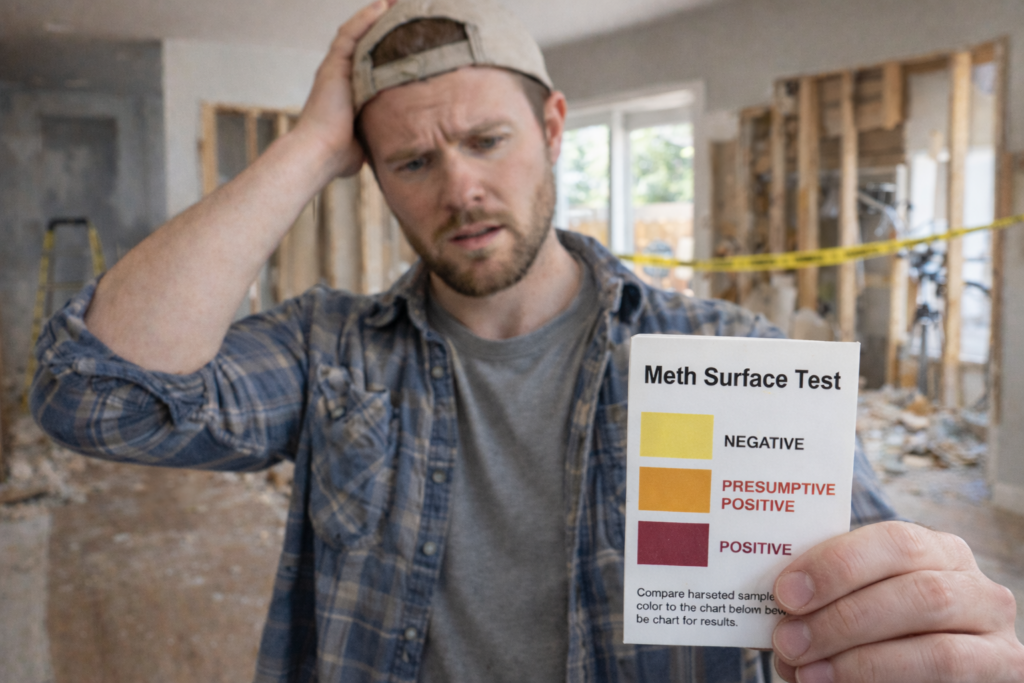
Once testing confirms contamination above the threshold, several legal realities lock into place:
1. Occupancy Restrictions
The property may not be legally occupied until remediation and clearance are complete. This applies to:
• Owners
• Tenants
• Short-term rentals
• Commercial occupants
2. Mandatory Remediation
Remediation must follow CDPHE-recognized protocols, including:
• Containment
• Removal of impacted materials
• Detailed surface decontamination
• HVAC system treatment when applicable
Shortcut methods increase the likelihood of clearance failure and future liability.
3. Independent Clearance Testing
Clearance testing must be performed by an independent third party. The remediation contractor cannot test their own work.
This separation protects:
• Buyers
• Lenders
• Courts
• The integrity of the transaction
4. Documentation & Record Retention
All remediation and clearance documentation must be retained and made available during:
• Sales
• Leasing
• Due diligence
• Financing
Missing or incomplete documentation is a common reason transactions stall.
Disclosure Obligations in Colorado Real Estate Transactions
Meth contamination is considered a material defect once known or reasonably suspected.
This means:
• Sellers must disclose
• Agents must not conceal
• Investors cannot “play dumb”
Even after successful remediation, documentation remains critical. Clearance mitigates risk—it does not erase history.
Failure to disclose has resulted in:
• Post-closing lawsuits
• Contract rescission
• Professional discipline
• Insurance disputes
In short: compliance protects everyone involved.
Why CDPHE Enforcement Is Increasing
In recent years, enforcement has shifted from reactive to proactive.
Contributing factors include:
• Increased meth lab identification during renovations
• Greater lender scrutiny
• Post-sale health complaints
• Better inter-agency data sharing
CDPHE now reviews documentation more closely and is increasingly involved when:
• Clearance fails repeatedly
• Properties change hands quickly
• Improper methods are suspected
The days of “good enough” remediation are ending.
How This Impacts House Flippers and Investors
For flippers, meth contamination introduces three risks:
-
Timeline Risk – remediation and clearance take time
-
Capital Risk – improper cleanup often costs more later
-
Exit Risk – buyers and lenders demand proof
Experienced investors now treat meth contamination as a compliance project, not a construction line item.
Those who don’t often discover the problem mid-transaction—when leverage is gone and deadlines loom.
Why Contractor Selection Matters Legally—Not Just Practically
Not all cleanup companies understand regulatory compliance.
A compliant remediation partner must understand:
• CDPHE methodology
• Clearance consultant expectations
• Documentation standards
• Real estate transaction pressure
DenverDecon operates with compliance as the starting point—not the afterthought. Their role is not just removal, but regulatory alignment, ensuring remediation stands up to consultant review, lender scrutiny, and future due diligence.
The Only Way Forward Is Full Compliance
Once meth contamination is identified, there is no workaround that survives scrutiny.
There is only:
• Proper remediation
• Independent clearance
• Complete documentation
Anything else delays occupancy, jeopardizes sales, and exposes every party to unnecessary risk.
Conclusion: Meth Contamination Is a Legal Problem First
In Colorado, meth contamination is not solved by cleaning harder or moving faster. It is solved by following the law precisely.
Understanding the requirements early prevents panic later—and turns a stalled property into a compliant, marketable asset.
(FAQS)
-
Is meth remediation required by law in Colorado?
Yes. If contamination exceeds 0.5 µg/100 cm², remediation and clearance are mandatory. -
Can a meth-contaminated property be sold as-is?
Disclosure is required, but financing and occupancy are often restricted without clearance. -
Who enforces meth remediation laws in Colorado?
The Colorado Department of Public Health and Environment (CDPHE). -
Does clearance testing have to be independent?
Yes. Contractors cannot test their own work. -
Can sellers live in the home during remediation?
No, occupancy is restricted until clearance. -
How long does compliance usually take?
Several weeks, depending on contamination extent and testing schedules. -
Is odor removal enough to meet the law?
No. Surface contamination must meet clearance limits. -
What happens if clearance fails?
Additional remediation is required before retesting. -
Do lenders require meth clearance reports?
Increasingly, yes—especially for FHA and conventional loans. -
What protects sellers legally after remediation?
Proper documentation and independent clearance reports.